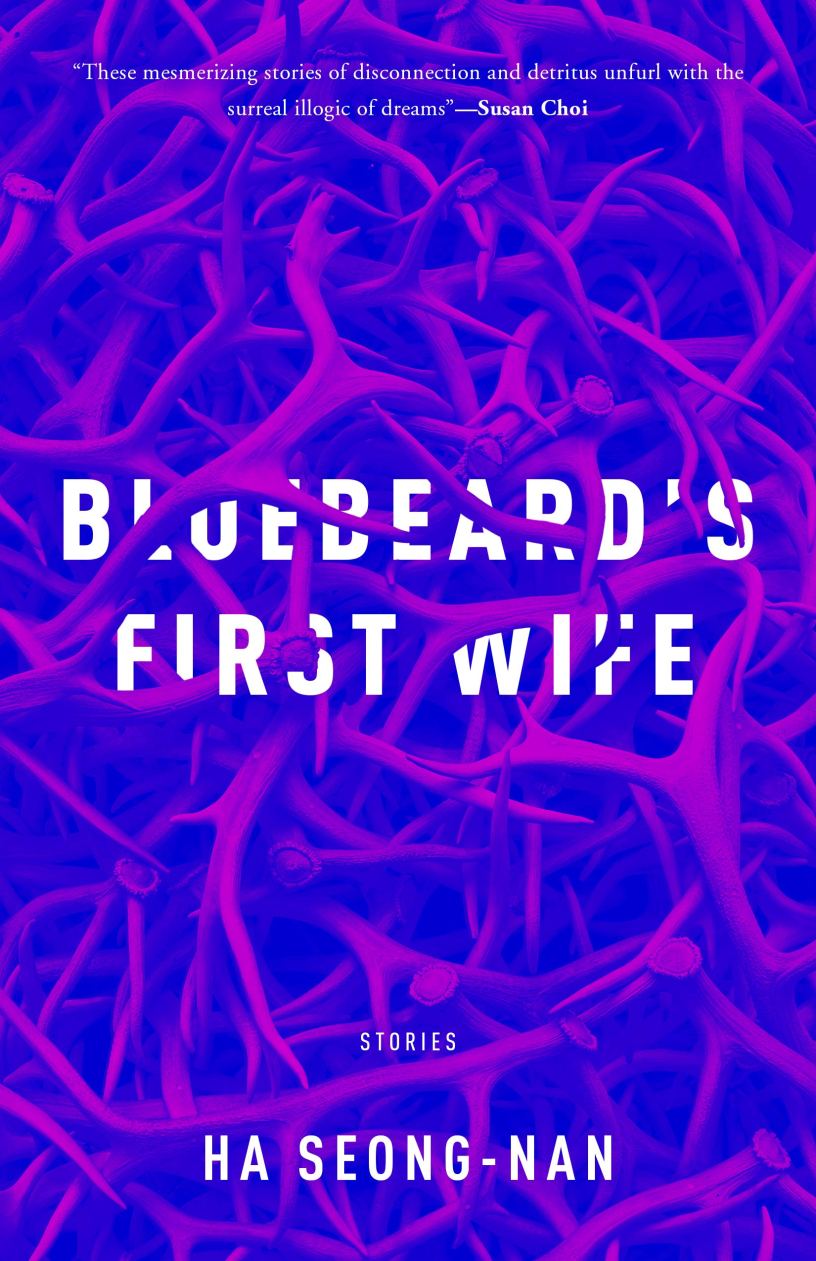
Bluebeard’s First Wife
By Ha Seong-Nan
Translated by Janet Hong
(2002, translated 2022)
Open Letter Books
(Short-story Collection)
Ha Seong-Nan is also the author of Flowers Of Mold, a collection of short stories published in 1999. This collection was published just a few years later, in 2002. Flowers of Mold focused on the stories of women who were trapped in relationships or marriages that left them physically and emotionally exhausted. In that collection, Ha’s vision of modern love was invariably bleak; a kind of love appears, followed quickly by a shrinking of view, inspiration, confidence, or hope. The day-to-day functions of couples involve, in many cases, the staving off of dread or decay. Echoes of that tone appear in Bluebeard’s First Wife, though Ha keeps her penchant for body-horror and the grotesque low-key and allows a lot more fresh air into her stories, including a fair degree of black humor. Like Angela Carter’s Bloody Chamber, Ha retells the cautionary tale of Bluebeard. The teenage bride is a bookish career woman who was at a stage in her life when she had accepted that she would never have a great romance and was content being unmarried. However, when a handsome, successful older man asks her to marry him and join him in his home in New Zealand, her parents are thrilled. Her father, a teacher, is especially delighted. When his daughter was born, he planted a princess tree, a fast-growing and beautiful tree that is traditionally harvested and made into a wardrobe for brides. The father invests great care in explaining the tradition behind his wedding gift, the unique qualities of the wood, and the steps involved in turning the tree into a piece of furniture. There is no castle in this version of Bluebeard, nor is there a forbidden room. But the new wife will explore and open a door perhaps better left unopened. Her response to what she discovers is immediate understanding and support, though her husband is so upset that in the first moments of panic, he almost turns her princess wardrobe into a casket. In this version of the story, everything turns out fine in the end. The bride lives ever after, the husband goes on with his life, and the real monsters seem to be the parents of the husband, who believe that their family status depends on their successful son marrying and fathering a son. All the stories in the collection seem to be modern cautionary tales, though the lessons come in muted, unexpected, and troubling ways. Ha’s adults are often out to make the vision of the life they planned since the days of their childhood come true, and when their reality fails to match their dream, they act out in chaotic, self-destructive ways. She tells tales about the disappointment a banker feels when he takes early retirement to learn to become a carpenter and discovers that he misses exercising his power to manage people, or about what happens to parents who have lost a child or who seem unable to understand how to love their physically disabled son. There are also predators. In one tiny, shrinking rural community, the townspeople conspire to trap new blood and bind them to the land through marriage, in another, a resort town depends on the business of seasonal hunting to stay in the black, even if some costs might be too big to pay. In all of the stories, Ha is able to pull off a moment (or moments) when she pulls the rug out from under her protagonists and they realize they are not where they thought they were and that any sense of security or human decency has exited the scene, sometimes permanently. Ha’s shifts are as devastating for the reader as they are for the characters. In addition to “Bluebeard’s First Wife,” there are other short stories that are explicitly linked to the world of European fairy tales, such as the reference to the Pied Piper in “A Quiet Night,” and perhaps there are allusions to East Asian tales as well. One wants to reread each story almost immediately to find the clue to the seed of the tale; this may be a pointless goal, as many of the characters realize too late that the story they thought they were living is not that story–or their story–at all.
“The first tree you cut down is called a modong. When it re-sprouts from the stump it’s called a jadong. When it re-sprouts again it’s called a sundong. Sundong princess trees are the best, in terms of quality. I’m going to watch over that tree and make a wardrobe for our daughter from the jadong and one for our grand-daughter out of the sundong.” (27-28)
 East Asian Literature in Translation
This was on my reading radar a while back… glad to hear the horror elements are kept low-key. I think I’ll put this back on the list!
LikeLike
I still shudder every time I think about one story in Flowers of Mold. Just horrifying! I hope you enjoy Bluebeard’s First Wife!
LikeLiked by 1 person