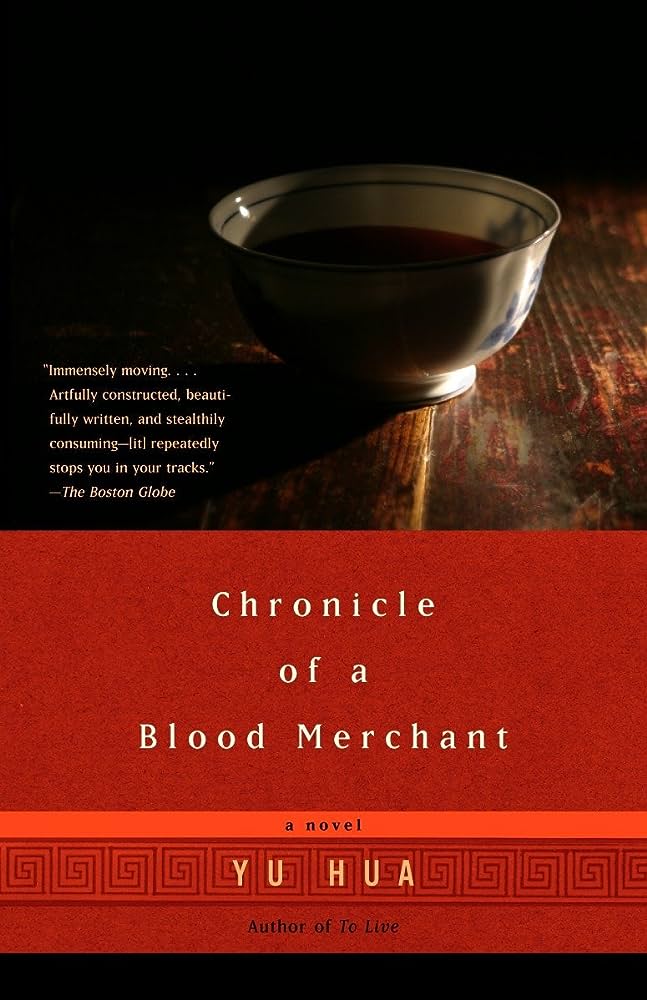
Chronicle of a Blood Merchant
By Yu Hua
Translated by Andrew F. Jones
(1995, translated 2003)
Anchor
(Novel)
Yu Hua is also the author of To Live. In this novel, Yu chronicles the period between the origins of the People’s Republic of China in the 1940s through the end of the Cultural Revolution in the 1980s. His hero is Xu Sanguang. From the start, his life, extended family, and the culture of his community are focused on and dependent upon selling blood in order to survive. A visit to a senile grandfather begins not with “Have you eaten?” but “Have you sold your blood too?” The grandfather chastizes his grandson–whom he mistakenly thinks is his son–for “not following the rules.” This is how Xu Sanguang discovered that his father violated Confucian law by choosing a wife before his two older brothers, and also how we learn that in this community, the practice of selling blood is a familial duty for any healthy male. On his first trip to sell blood, he meets two veterans of the trade, Ah Fang and Xenlong. They explain that they earn 35 yuan each when they sell their blood and reveal to their new friend their strategy: each time they visit the hospital, they make sure to bring melons to Blood Chief Li, the man who decides who from the many sellers will be able to sell blood that day. The three become a team and establish a tradition: each time they sell their blood, they will recover afterward by sharing a meal at a wretched dump called The Victory Restaurant. From that moment on, Sanguang regards his purpose and value as a man, husband, and father in his ability to feed his family by selling blood in times of crisis. He works as a laborer in a factory that processes raw silk, marries Xu Yulan, and he and his wife have three children together. Their world suffers upheavals as Mao’s commandments begin to roll like destructive waves across China. The Great Leap Forward in 1958 leads to famine and Xu Sanguang must increase the frequency of selling his blood in order to keep even gruel on the family table. A greater blow comes when he discovers that his eldest son, Yile, is not his own but the result of a one-night stand between his wife and her ex. This becomes another test of his role as a man, father, and husband. If they are not related by blood, is the boy his son at all? Does Sanguang owe anything to the child? Will he sell his blood to feed him? And what further challenges will Sanguang face during the Cultural Revolution? Please be advised that there exists a Korean film called Chronicle of a Blood Merchant. Director Ha Jong-Wu removed all of the political elements of Yu Hua’s novel, set the story in Korea just after the Korean War, and marketed the film as a comedy-drama. Avoid the movie, but do not forget that amid the tragedies that befall the characters in Chronicle of a Blood Merchant, Yu Hua offers many scenes of double-edged humor, as seen below:
“Xu Sanguan added, ‘Xu Yulan is your only child. If she were to marry He Xiaoyong, your family line would be broken for good, because no matter whether the kids were boys or girls, their last name would still have to be He. And if she married me? My last name is the same as yours, Xu, so no matter if we had boys or girls, they would all be named Xu. Your family line will remain intact, and you’ll always have descendants to burn incense for you at the family shrine. Look at it this way—if I marry Xu Yulan, it would be just the same as if I agreed to take on your family name instead of making Xu Yulan take mine.’
When Xu Sanguan’s speech reached this juncture, Xu Yulan’s father broke into a wide grin. He looked across the table toward Xu Sanguan and, drumming a tattoo on the tabletop with his knuckles, said, ‘I’m going to accept this bottle of wine, and the carton of cigarettes. What you say is absolutely right. If my daughter marries He Xiaoyong, my family line will be broken forever. But if she marries you, both of our family’s futures will be assured for generations to come.’
When Xu Yulan was informed of her father’s decision, she sat on the bed, tears falling from her eyes. Her father and Xu Sanguan stood to one side. Watching as she wiped the tears from her face, Xu Yulan’s father said to Xu Sanguan, ‘Take a good hard look. This is what women are all about. When they’re truly happy, all they can do is cry.’”


Great review! Now I want to check it out!
That era of Chinese history is so tragic and fascinating. As much as the government tries to gloss over what happened, at least we have stories such as these, by brave authors and translators, to remind us of the reality.
LikeLiked by 1 person