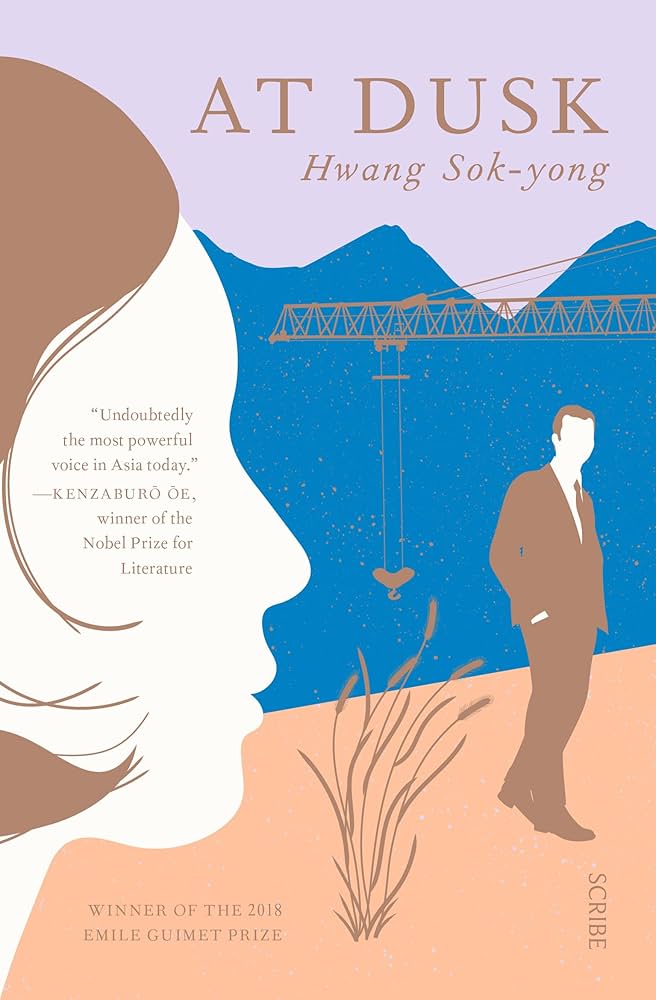
At Dusk
By Hwang Sok-yong
Translated by Sora Kim-Russel
(2015, translated 2018)
Scribe Publications
At Dusk follows Hwang’s Familiar Things, a fictional account of the real-life denizens of “Flower Island” in the 1980s, the outcasts who lived by selling recyclable refuse while residing in and around Seoul’s largest open-air refuse dump. Familiar Things exposes one of the many downsides of Korea’s rapid economic growth under the cruel leadership of political strongmen. Hwang forces 21st-century Koreans to look back at the “Miracle of the Han” by focusing on the way Korea polluted itself and its national river by allowing unregulated dumping of chemical, military, construction, household, and human waste on Nanjido Island. At Dusk also looks back at Seoul’s rapid transformation from a war-ravaged wasteland to the economic powerhouse of the 80s and 90s. The embodiment of this transformation is Park Minwoo, whose family emerged from the war broken and impoverished. Young Park’s options are simple: join a gang or go to school. Inspired by his love of a girl he associates with purity and intelligence, he chooses an academic path. Diligent, talented, and fortunate in his friendships, Park joins an architectural studio right out of college. Over the last fifty years, he has seen his designs contribute significantly to Seoul’s unrelenting modernization. Now divorced and alone, Park watches anxiously as associates in major construction firms are being investigated and put away for corruption. Nostalgic for the days of his youth spent in Moon Hollow, he Googles the name of his childhood home and discovers there is no record of the site. He learns that organized crime bosses forced the people out so that builders could flatten the site and erect faceless concrete towers and accept that his success contributed to the erasure of communities and local histories. Hwang’s second character is a young playwright struggling to make ends meet. She works several jobs, rents a tiny, dark apartment, lives frugally, and nevertheless feels that she will ultimately lose the rat race in 21st-century Korea–what Koreans call “Hell Joseon.” The two characters are worlds apart, but Hwang brings them together in a way that is as beautiful as it is unexpected.
Hwang Sok-yong devoted much of his life to publicizing and demanding justice for the people who suffered and died during the Gwangju massacre in May of 1980. In the excerpt below, Hwang’s protagonist Mr. Park bluntly acknowledges that he and his firm profited from this national tragedy, as they were hired to rebuild after the violent conflict:
“…I found the time to apply for a government-sponsored study abroad program, and I passed. That was the same year that all that trouble happened in Gwangju. The country was in turmoil. We were under martial law. Tanks were parked on city streets, and special forces soldiers in full camouflage and carrying bayonets stood guard outside TV and radio stations, government offices, and school gates. Rumours were quietly spreading of a civilian massacre in Gwangju.
I’d never been to Gwangju in my life, but after hearing the whispers of older colleagues, who in turn had heard whisperings from others, the fact that I had no connections to Gwangju didn’t put my mind at ease. We all had a pretty good idea of how the previous president had died the year before, and we knew exactly what sort of ambitions the new military-led regime held. But regardless, what we were constantly weighing was whether and how the prevailing political winds would affect our own plans. We took the crumbs that those in power tossed our way and used them to grow our own wealth. And even if we did privately feel some guilt about it, we all knew the feeling wouldn’t last.”


I could not connect with this novel or its characters when I first read it (perhaps because I was too impatient), but after reading your review, I will give it another go. A beautiful review, thank you.
LikeLiked by 1 person
I often find myself searching for ways to explain the challenges of reading Chinese works that have been translated into English. I feel comfortable reading all sorts of Western literature. I recognize the structures and I hold many of the keys to the figurative language. And like you, I am so impatient!I every once in a while I’ll realize the writers are having a great old time and enjoying the giddy liberation that comes with creating subversive art. A coward myself, I admire their daring as they roast their corrupt overlords via in-jokes and winks and nods. Sometimes I stumble on an audiobook performed by a talented reader who can reveal a tone that might not be immediately apparent in the text. Good luck to you!
LikeLiked by 1 person