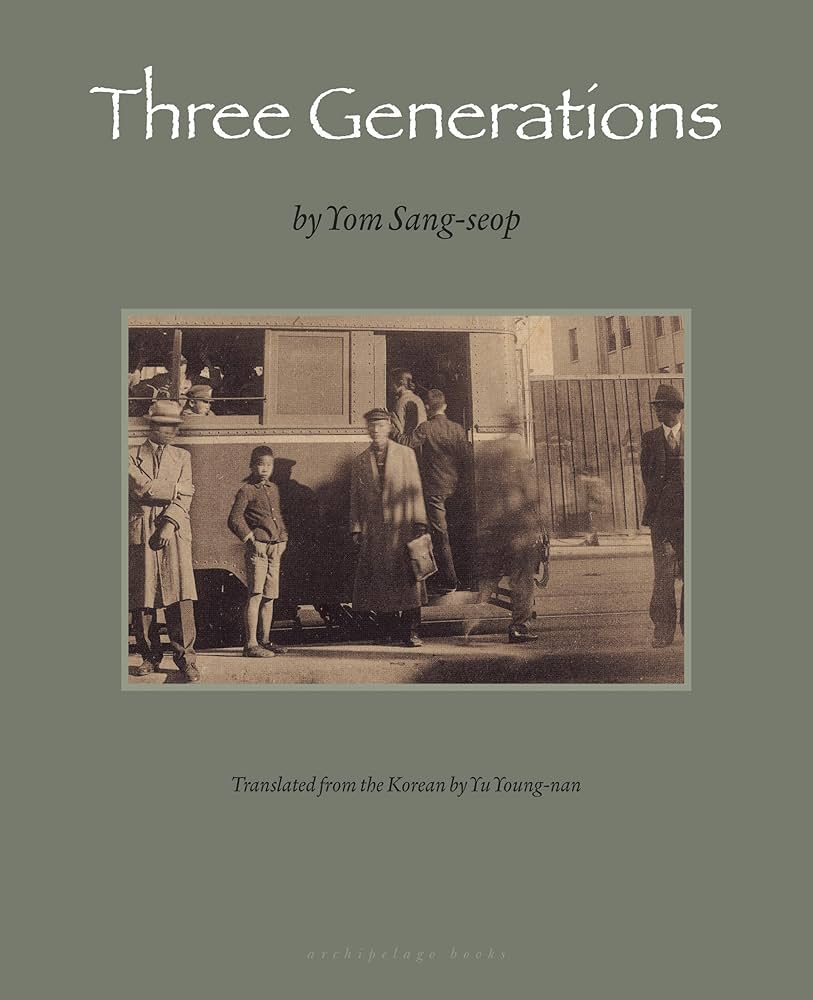
Three Generations
By Yom Sang-seop
Translated by Yu Young-nan
1931, translated 2005
Archipelago Books
Yom Sang-seop’s Three Generations was published serially under the Japanese occupation, which is remarkable, given the openly political strand of its complex plot line. It is the story of two old school friends, the deep-thinking and deep-feeling scholar Jo Deok-gi, “born into a leisure class family,” and the impulsive Byeong-hwa, who wears his poverty and his politics as badges of honor. Together, the patrician and the prole trade criticisms of class consciousness and political ideologies that often serve as the lighthearted preliminary for Byeong-hwa to ask his well-heeled friend for a smoke, a drink, or a loan. The inciting incident takes place when Byeong-hwa drags Deok-gi to the wrong side of town to check out a girl who works at Bacchus, a shabby spot that sells makgeolli. The girl in question, Gyeong-ai, immediately identifies Deok-gi as a “modern boy.” Dressed in a western suit, educated at Waseda University in Japan, he is most definitely a type. But Modern Boy is also the title of a popular movie of the time, which features a romance between a young man from the bourgeoise who is seduced by a worldly communist agent. And, as it happens, Gyeong-ae is indeed a communist who, along with Byeong-hwa, shelters and provides support for local cells and high profile agents fleeing the Japanese. On meeting the beautiful and flirtatious Gyeong-ae, Deok-gi immediately recognises her as a former classmate and the young lover of his father, Hang-yun, a gambler, a lecher, and authoritarian church elder. While still reeling from the discovery that his self-righteous father is tied up with a “Marxist girl,” Deok-gi meets the humble daughter of Byeong-hwa’s landlord. Immediately enamored of this poor factory girl, he imagines using his means to send the child to Japan to be educated. Byeong-hwa questions his friend’s so-called philanthropy and suggests he merely wants a lover, causing Deok-gi to protests that he and his wife are happily married. Truth be told, his father arranged that marriage, choosing a faithful, uneducated believer from the country as his scholarly son’s partner. Now he sees in the virginal beauty of the factory girl the opportunity to create the intellectual he long dreamed of marrying. The Three Generations of the title alludes to the relationship between Deok-gi’s grandfather, who represents the landowning class of the feudal period, Deok-gi’s father, a type of Korean who has abandoned his Korean identity and embraced all the beliefs and decadence of the west, and Deok-gi himself, who is trying to determine his role in society and in his family. Yom Sang-seop pulls off a tour-de-force, skewering the faults of each generation, the Japanese occupiers, and the follies of the male ego, and he also manages to weave in a plot to alter the grandfather’s will, a murder or two, altering a family genealogic register to elevate the status of the Jo clan, and and an attempt to free old comrades from a colonial jail. Three Generations is essential reading for anyone interested in the complexities of life in Korea during colonial rule.
“The old man would be the first to admit that he’d taken several dubious paths. First, at the age of forty, he grabbed hold of a government position by paying twenty thousand nyang, four hundred won in today’s money, amid the confusion of the 1905 Protectorate Treaty with Japan. So, although the position was bought, his current title, Adviser, was not totally unjustified. Second, he took in the Suwon woman six years ago, soon after his wife’s death. The cost, twenty thousand nyang, was nothing to sneeze at, but the woman had given him a daughter—Gwi-sun—and if he hadn’t taken such measures, there could be no dream of a son mourning him when he dies. All things considered, the cost of the Suwon woman had been worth it. Taking over the genealogy office was the old man’s most recent indulgence. This time, he was drawn into a major venture, and spent as much as two hundred thousand nyang, ten times the amount he’d spent on the Suwon woman, to create the genealogy center. It is difficult to belittle the venture, even if it went against the spirit of the times. Though Sang-hun didn’t particularly object to the genealogy office, neither did he feel any urgency to promote the new project. However, when his father put up a precious four thousand won in an effort to worm himself into this particular faction’s genealogy book, Sang-hun thought he was definitely off his rocker. Buying yangban status! It was humiliating to Sang-hun.”

