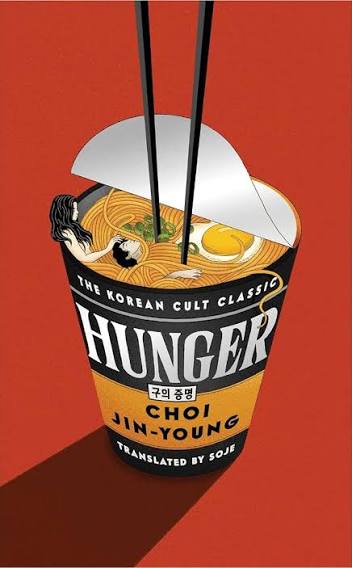
Hunger
By Choi Jin-young
Translated by Soje
2015, translated 2025
Europa Editions
Hunger, by Choi Jin-young, is a short, disturbing novel told by a despondent young woman, Dam, who opens her tale by invoking the forces of a world-ending Christian apocalypse. She reveals that she just witnessed a murder and confesses that she is in the process of committing her own unspeakable crime. Dam then explains the history of the bond she shares with her next door neighbor, Gu. They met as children. Dam claims that they knew from the start that they were two of a kind and destined to be together. They create a world apart from adults and other children, one that is nearly silent. Their parents express concern about the excessive amount of time they spent together but do little to keep them apart. As they enter middle school, the objections of their parents grow louder, but Dam insists the love she and Gu share is both chaste and everlasting. In time, they drop out of school. They live together in a rented room and spend their days working in dead-end jobs. Determined not to contact their parents, Dam and Gu fall into a cycle of getting and losing low-paying jobs, failing to meet rent, and setting up again in smaller rooms and more dangerous neighborhoods. From the start, Choi portrays the pair as obsessive in their need to be by each other’s sides at all times, so much so that Dam’s narrative becomes increasingly claustrophobic. Dam characterises the love she shares with Dam as a wedding of two souls, yet Choi , determined to test them, plunges the lovers into the hell of late stage capitalism in contemporary Seoul and an all-consuming culture of work and debt. If the couple’s parents appear to be disinterested in the fate of their children, it is because they are working long hours to keep from losing their apartment. Working has become their sole reason for living; when one family member dies before reaching retirement, few pause long enough to grieve. Worse yet, Gu’s family has inherited a crushing debt and fallen into the grasp of moneylenders; if his father fails to work the family to freedom, Gu will become responsible for the money owed. Choi’s lovers create challenges for readers, as so much of their feeling for one another is unsaid and focused inward. We sense their struggle, but we are outsiders looking into a very closed world. The more rewarding path to take with Hunger may be to pursue Choi’s framing of their story within a Hebraic and Christian universe.
“Before I met my aunt, I lived with my grandfather. When he passed away, she gave up her life as a Buddhist nun in a mountain-top temple and came down to meet me. Neither of us knew of the other’s existence; his death brought us together.
So the aunt hadn’t known she was an aunt, and the niece hadn’t known she was a niece.
Auntie had no idea how I came into the world, or how I ended up living with my grandfather. Neither did I. Grandpa took his secret to the grave. I think he had meant to say something to someone, but death took him by surprise. So both Auntie and I remained in the dark. We got by on our wits, without knowing the basic facts and oblivious to our own ignorance. Some secrets are better left undiscovered. Thinking too much only messes with you and brings on headaches. You might end up questioning your entire existence.”

