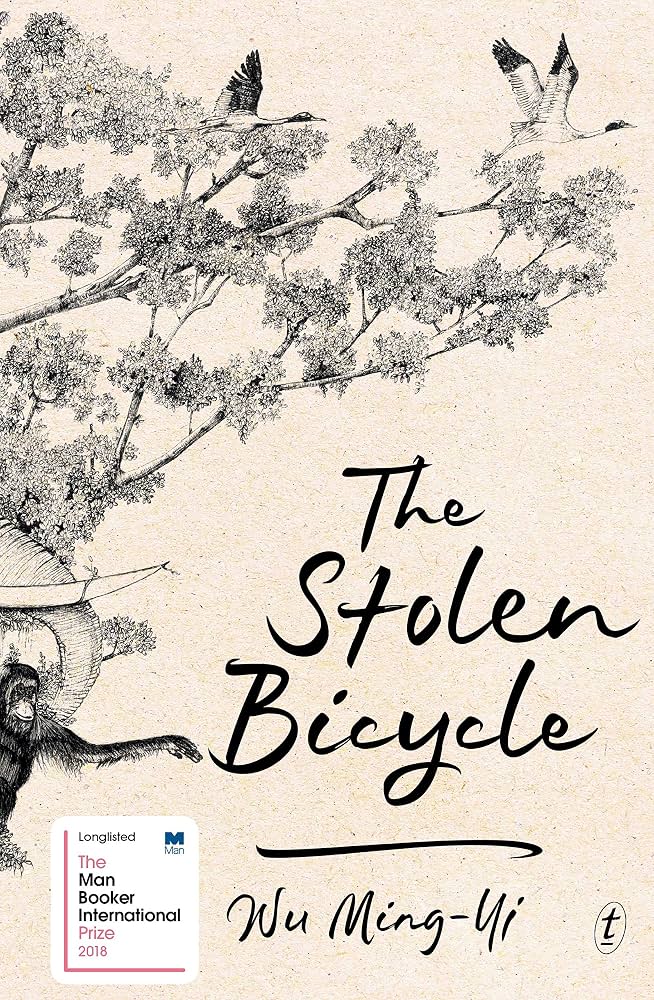
The Stolen Bicycle
By Wu Ming Yi
Translated by Darryl Sterk
(2015, translated 2018)
Text Publishing Company
Wu Ming Yi begins “The Stolen Bicycle” with a pair of line drawings. The first is of a bicycle, a 1915 Territorial BSA Modele deLuxe 1A. Labels and arrows identify each part of the bicycle, yet the artist does not provide any information about the most unanticipated and extraordinary item in the drawing, a military rifle mounted to fixed clips at the down and head tubes. The second drawings feature an illustration of Taiwan’s historic buildings and infrastructure and a timeline of one hundred years of Taiwan’s history, beginning in 1901 and commemorating the building of the first Meiji era bridge. The second major event Wu features is in 1915, when he claims Taiwan’s major newspaper reported its first of many thefts of bicycles. Tellingly, Wu omits the Tapani Incident of 1915, when an alliance of Han Taiwanese, Taivoan, and other indigenous peoples rose up against the Japanese colonizers. The Japanese put down the rebellion and in the aftermath, destroyed tribal villages. Wu’s narrator is a writer of some success who commits to finding his father, who disappeared some twenty years before and his family’s beloved “iron horse” bicycle. He explains that for three generations, his family’s fate has depended on bicycles, and that to own a bicycle in Taiwan was both a ticket to financial stability and a means toward shaping one’s fortune. To find his father, the narrator explains that he must recover both his family’s history and a series of their stolen bicycles. Already in love with the allure of Taiwan’s bike culture and the fanaticism of its followers, Wu’s narrator shapes his investigation like a historical materialist. He finds bike parts, legends of bikes, reconstituted bikes, and follows these to their owners or those who knew the owners. He asks them to tell the story of their bicycle and listens to the story of their lives. Wu introduces us to many compelling storytellers who report on their own experiences and what they witnessed and, in this way, however indirectly, Wu builds a living record of 20th-century Taiwan. Though he pursues the most tenuous threads of happenstance and coincidence, improbably, he finds witness after witness. We come to know each one of his informants intimately, and their stories are as epic and compelling as our intrepid narrator. If the trail ever falls cold, the narrator uses the time to tell us about each of the bikes he owned in his life, as well as those he encountered “in the wild.” The narrator travels deep into the interior of the country and visits members of Taiwan’s indigenous communities and immerses himself in a natural world he otherwise could never have imagined. This episode is one of many in which Wu uses magic-realism and an examination of the plurality of the island’s languages to bring life to a complex world that has endured and survived wave after wave of colonization. In his “Translator’s Note,” Darryl Sterk explains not only the degree to which Wu slips in and out of Mandarin, Taiwanese, and Japanese, but also how he embraces a variety of distinct dialects, as well as indigenous languages, which required him to bring in special translators to assist him. “The Stolen Bicycle” is a bold experiment in storytelling, legend, and historiography, by turns comic and tragic, and a worthwhile read for anyone interested in the history and culture of Taiwan.
“‘I feel like the latter half of the bicycle’s story—no, I should say the first half of its story—is not mine to tell. It’s better for you to hear it from Pasuya. But it’s not easy to understand what he’s saying, because he switches between Japanese and Tsou, and rambles on about things that happened during the war. I can get an old fellow in the village to help with the Tsou, but for the Japanese you’ll have to get your editor friend to listen and translate. And the quality of the recording isn’t very good…’”

