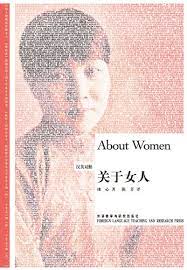
About Women, by Xie Bixin
Translated by Mao Chen
(1941, translated 2012)
Foreign Language and Teaching Press
Xie Bingxin is considered the first noteworthy Chinese woman writer of the 20th century. Her pen name “Bing Xin” means “Ice Heart,” which carries the connotation in China of someone of pure heart. Xie Bingxin studied at Wellesley College in Massachusetts and worked and traveled in Europe. She wrote About Women in 1941, publishing it serially in a Chongqing weekly. The concept of the project is intriguing: adopting the persona of a “womanly” forty-year-old man, a scholar who never married, she reveals her narrator’s biased understanding of women while also revealing what life is like for both the traditional Chinese woman as well as the Chinese woman who is inspired to live a more independent or modern lifestyle. Her narrator is deliciously incapable of self-awareness and reflection. Relatives and dinner guests are forever complaining that he has not married and openly tease him for his lack of masculine traits. Xie Bingxin’s narrator thus presents a point of view that is male while existing in a space that is neither completely masculine nor entirely feminine. Throughout her text, the author gives a variety of nods to feminism in China, while also directly referencing the politics of the age. Her narrator writes from Chongqing, the seat of Sun Yat-sen’s United League of China, and the capital of China during the resistance against the Japanese. The narrator references the May 4th movement, the Lugou Bridge incident of 1937, and there is a family wetnurse whose father died after the Japanese seized his property. Characters refuse to accept gifts made in Japan and deface the Japanese flags that appear in a history of the Russo-Japanese War. About Women is a complex piece, a satire of gender politics with a decidedly nationalistic point of view. One of the earliest entries, about the heroic strength and modern values of the narrator’s mother, emphasizes her study of and involvement in her country’s politics, at home and abroad.
“It would seem, anyway, somewhat awkward for a gentleman to write something about women. People would wonder: Isn’t it a kind of satire? Or ‘Isn’t it due to some disappointment in love?’ As if only women were justified in talking about women. But I believe actually that women should be talked about by men, because the viewpoint of the latter may be more objective and their attitude more polite.” (1)

