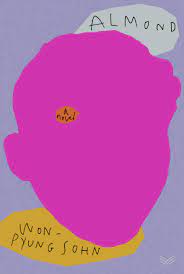
Almond, by Sohn Won-Pyung
Translated by Sandy Joosun Lee
(2017, translated 2020)
(Novel)
Sohn published her novel originally under the Korean title The Love Technique. In many ways, the title is entirely appropriate, as Sohn was initially inspired by the question “Is it possible to love an unlovable child?” Similarly, her central character is in a position where love is an emotion that is unknowable to him, and therefore he must approach love as a foreign technology he must study and imitate in order to survive.
After an ordinary birth, Seon Yeonjae begins missing developmental benchmarks. More alarming to his mother, he never smiles. At the age of four, she begins a quest to discover what is wrong with him. Many doctors report that he is perfectly healthy. Some suggest he might simply be a quiet child, while a few intimate that the boy may be autistic. Eventually, an MRI reveals that Yeonjae’s amygdalae are abnormally small. The almond-like glands control our fight-or-flight behavior. Their lack of development explains Yeonjae’s inability to decode social cues or feel pain, fear, or affection. His mother and grandmother take it upon themselves to train the boy as if his “almond” were a muscle, rehearsing social situations and trying to help him to recognize and avoid danger. The children at school are frightened by his robotic affect and lack of emotion or empathy; they begin referring to him as “monster.” Midway through his training, he loses his mentors, and soon he finds himself the target of a new bully at school who is so savagely cruel that even Yeonjae can recognize that he, too, is a monster. The bully, an orphan who adopts the name “Gon,” is drawn to torment and study Yeonjae because the budding sadist fantasizes that he will live a life of cruelty and desperately wants to toughen himself and weaponize his heart. As the boys enter their teenage years, their ability to feel matures and they grow to be comfortable with each other and even share a kind of friendship. But their bodies have become stronger and they are more capable of doing great harm, either by failing to act when necessary or by a ferocious compulsion to act out and control the world through explosive violence. In order to highlight Yeonjae’s isolation and emotional limitations, Sohn has Yeonjae narrate his own story. His voice is laconic and flat, almost always undercutting the tragedies and motiveless cruelty he witnesses. He observes in great detail and reports exactly what people say to him, explaining the confusion he feels when people try to reach out to him and recognizing the too-familiar posture and looks of people about to insult or challenge him. Sohn introduces a girl who is also an outsider and a target in the class; in many respects, as shocking and violent as the novel is, Sohn may be making a very simple case: not all children are the same, and attempting to mold or coerce them into being “normal” is more destructive than we can possibly imagine.
“Some of them made rather tempting offers, saying that I could play a big role in uncovering the mysteries of the brain. Researchers at university hospitals proposed long-term research projects on my growth, to be reported in medical journals. There would be generous compensation for taking part, and depending on the research results, an area of the brain might even be named after me, like the Broca area or Wernicke area. The Seon Yunjae area. But the doctors were met with a flat refusal from Mom, who was already sick of them. For one thing, Mom knew Broca and Wernicke were scientists, not patients.” (22)

