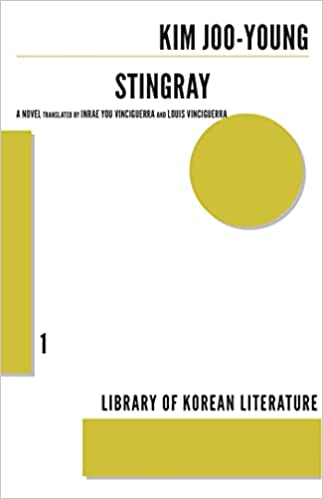
Stingray, by Kim Joo-Young (m.)
Translated by Inrae You Vinciguerra
(1998, translated 2013)
Library of Korean Literature
(Novel)
Stingray takes place in the 1950s in a rural village at the foot of the Tae-Baek Mountains in “snow country.” Snow is a major player in the novel; all of the major developments occur in winter, and the silence, beauty, and life-threatening nature of snow are always weighing on the characters. Snow affects the community: before a storm, villagers run ropes from house to house. They signal their safety by tugging on the ropes, and the first paths after the storm are made by swinging them. The ropes are perhaps the one element connecting the family at the heart of the novel to the villagers. Years before, the woman’s husband just walked off and abandoned his family. Since then, the woman has isolated herself from the community, fearing gossip and humiliation. The stingray she was preparing for her husband’s dinner she nails to a post by the front door; she expects him to return, she will cook the stingray, and their lives will go on as usual. Everything changes when, after a terrible storm, the mother and her son wake to discover a young woman asleep in their kitchen. She arrived in the night, crept inside for shelter, and before collapsing, ate the stingray. The mother is at first angry with the woman. But though she beats her with a rod, the woman remains in the house. Over time, the two become friends, and the young boy, the narrator, falls in love with her. That all changes when the young woman, Sam-rae, begins sneaking out at night and working as a “bar girl.” The mother, always focused on preserving her reputation, banishes Sam-rae. The young narrator, who may already resent his mother for failing to keep his father in the home, now blames his mother for erecting a permanent barrier between him and his beloved. Stingray is a slow and steady burn. The characters are intense and though not much happens, Kim manages to create taut suspense. The boy longs for Sam-rae to return and perhaps she will, and though the mother sent the woman away, she clearly suffers in her absence. Meanwhile, a male neighbor, the best friend of the absent father, continues to watch the family from a distance. He clearly cares for the mother; he may be in love with her. Is he waiting for her to surrender her delusion that her husband will return? Finally, there is the adolescent boy, baffled by the tragic turn in his parents’ relationship and tortured by his longing for his family and his growing desire to be reunited with the beautiful Sam-rae, who lives life minute to minute and cares not a whit for reputation. This novel took me by surprise; it may be among my favorite novels of marriage.
“She would calmly enter the room, dragging her heavy steps across the floor, and take a morning nap in order to rid herself of the fatigue accumulated during the previous night’s sewing. With her jeo-go-ri tightly fastened, my mother’s way of sleeping was very similar to Sam-rae’s, whose huddled posture somehow revealed her deep-rooted, bitter sadness and strange readiness to wake up at any time and immediately run a long way.” (35)

