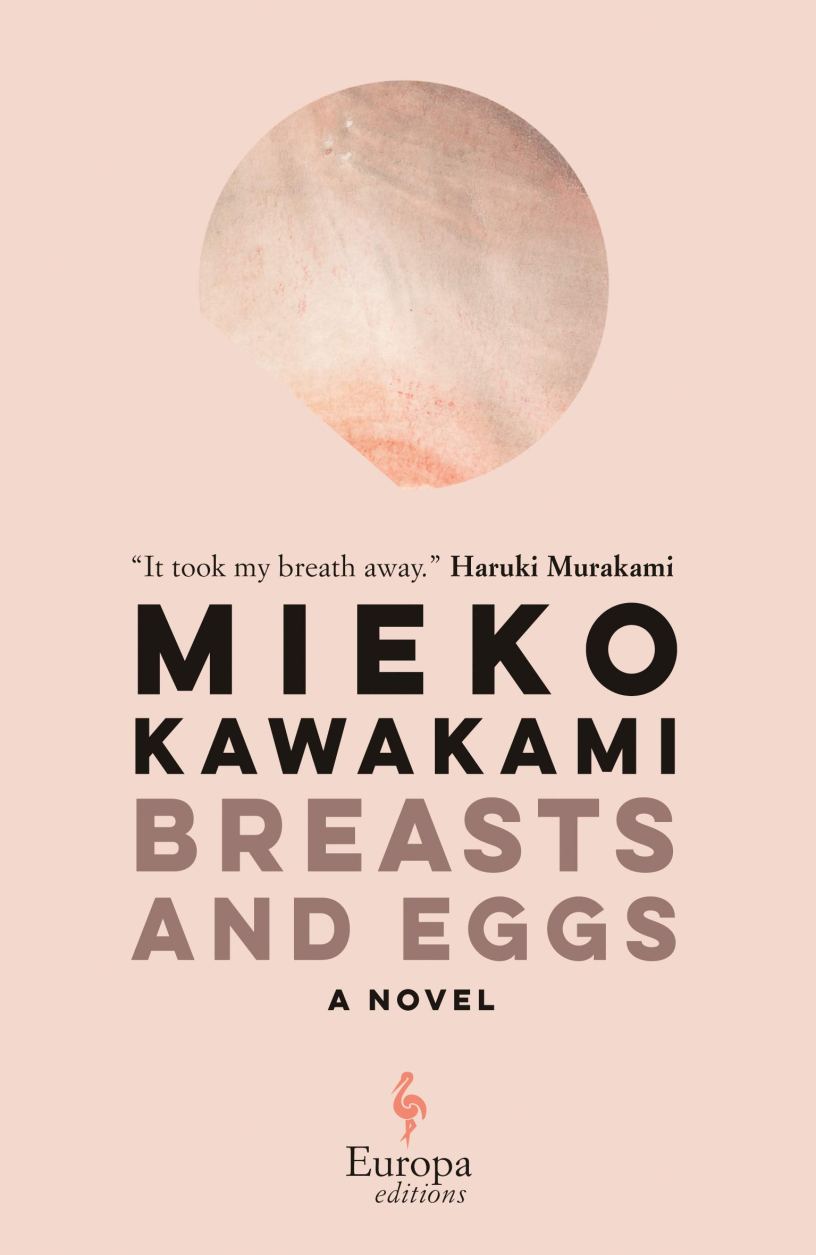
Breasts and Eggs, by Kawakami Mieko (f.)
Translated by Sam Bett and David Boyd
(2019, translated 2020)
Europa Editions
(Novel)
Kawakami came to writing after working as a bar hostess and as a successful pop singer, two careers where a premium amd a microscope are put on a woman’s beauty. There are two iterations of Breasts and Eggs. The first version focused primarily on the relationship between the narrator, the thirty-year-old Natsu, her thirty-nine-year-old sister Makiko, and her niece, twelve-year-old Midoriko. The ages are critical to the plot and the themes of the story. Makiko’s husband disappeared years ago; she has been raising her daughter on her own in Okinawa. Makiko works as a bar hostess in a mid to low tier club where men come to drink with attractive women. This is the only work Makiko has ever done, and it requires her to be out and drinking at least six nights a week. Her labor pays the rent and puts food on the table, but it drives a wedge between her and her daughter, who only sees her a few hours each day. Young Midoriko is anxious about the ways her body is changing or not changing (unlike the majority of the girls in her class, she has not begun to menstruate). She feels she can not approach her mother with these questions because at the moment Makiko is obsessed with going to Tokyo to have breast implants, no doubt to assuage her own insecurities and to prolong her money-making years as a hostess. Furious with her mother, Midoriko stops talking to her. That is the situation when Makiko and Midoriko appear at Natsu’s door in Tokyo. The second part of the novel takes place ten years later. Natsu is at a crisis: her work as a blogger and free-lance writer is dwindling and her progress on her second novel has come to a standstill. She thinks constantly of her aging body, her loneliness, and her desire to have a child. She reveals her first love, a deep relationship with a young man while she was in college. Although she loved him dearly, she found sex painful and emoptionally revolting. She has had no other relationships since then, and since she still refuses to consider sexual intimacy, she begins to research the legal and extralegal ways of contracting a suitable sperm donor. Just as much of the first half of the book provides an exhaustive study of the business, law, and social mores of breast augmentation, the second half provides a deep dive into the struggle of married and single Japanese women to find sperm donors. Kawakami’s characters are brutally, hilariously frank. Her sister is appalled by her efforts to bring a child into the world. Her female editor and fellow female authors, one single, the other a single mom, respond savagely to her desire to have a child. But Natsu’s research is fascinating. Reading about a man who only discovered after his father’s death that he was not his real father and that his mother had been artificially inseminated, she finds herself drawn to the experience of children born in this manner, a path that leads her in an unexpected direction Taken together, the two halves of the novel provide a study in what it means to be a woman– and especially a single woman–in contemporary Japan.
“Her fake teeth were noticeably yellow, and the metal made her gums look black. Her faded perm had thinned so much that you could see the perspiration on her scalp. She was wearing way too much foundation. It made her face look washed out and more wrinkly than it was. When she laughed, the sinews of her neck popped out. Her sunken eyes called attention to their sockets. She reminded me of Mom. (16)

