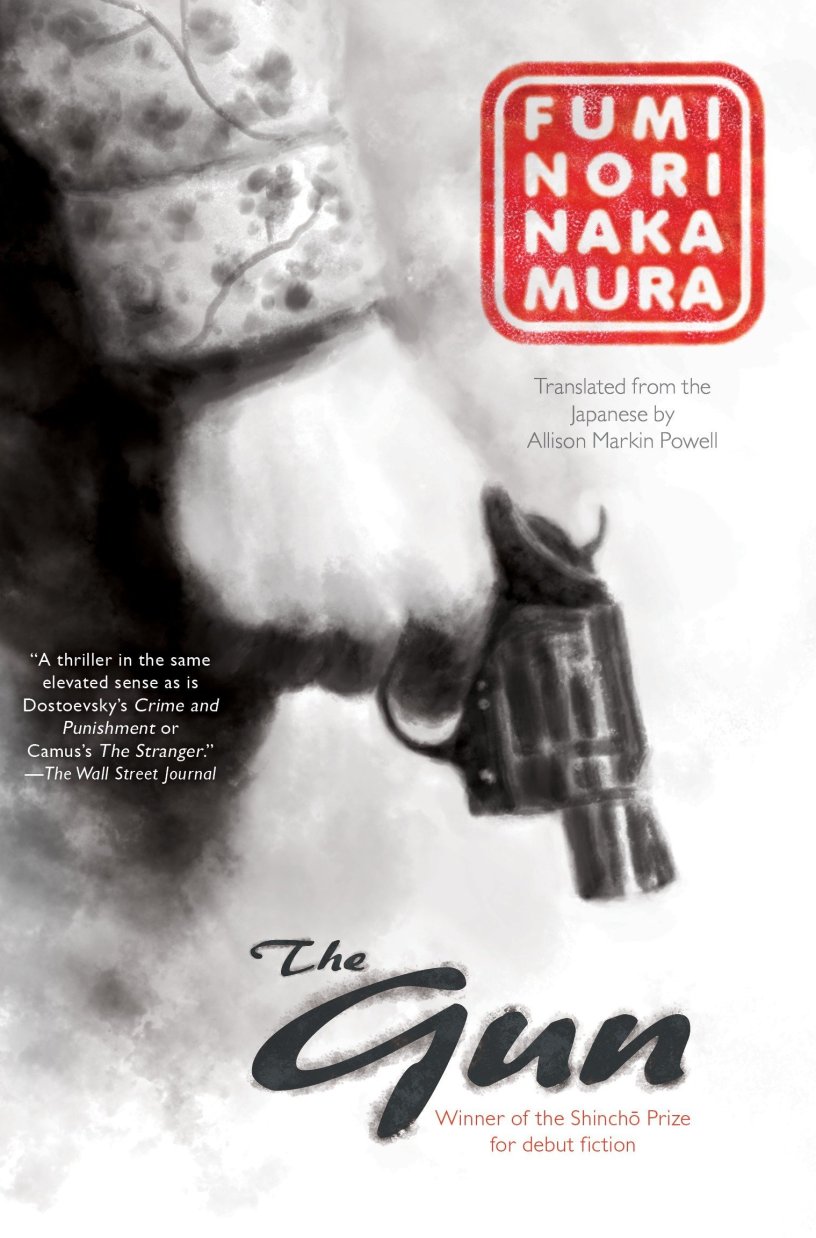
The Gun, By Nakamura Fuminori
Translated by Allison Markin Powell
(2003, translated 2017)
Soho Crime
(Novella)
Mr. Nakamura’s protagonist is a male college student drifting through his classes and his relationships. Like him, his classmates seem lost and incapable of making connections with one another as they drink their way to oblivion or crash into each other’s beds. Nothing seems to matter. From the start, the voice of the first-person narrator and the tone is reminiscent of The Stranger, but as the story flies along at an irresistible pace, troubled Nishikawa Turo sounds increasingly like Holden Caulfield. Seeking shelter in a rainstorm, Turo makes his way down an embankment and ducks under a bridge, where he finds a man sprawled on the concrete path. The man is dressed in a suit. His hair is graying; he may be in his late forties or early fifties. He is clearly dead. Turo examines the body and discovers a hole in the man’s head and a few feet away he finds a Colt magnum revolver. Private citizens are not allowed to own guns in Japan. Perhaps because of the taboo, or maybe because he panics, Nishikawa pockets the gun and takes it home. Almost immediately, his possession of the Colt alters his behavior. Perhaps having the weapon allows the young man the confidence to reveal more about himself and his troubled mind, or perhaps the gun itself is disrupting his thinking—in any case, in the days and weeks following his appropriation of the weapon, Nishikawa becomes an increasing threat to himself and the people with whom he interacts.
“I hardly ever used to evaluate my own past actions. I really didn’t make a habit of thinking too hard about right and wrong, or about the consequences that arose from either. But I feel something akin to gratitude for what I did that night. Had I simply gone back to my apartment, I wouldn’t have the gun in my hands now. In contrast, when I think about the possibility of never having had the gun, I am seized with a vague terror…” (3)

