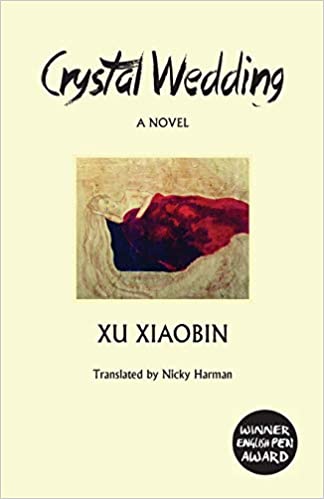
Crystal Wedding, by Xu Xiaobing
Translated by Nicky Harman
(2012, translated 2016)
Balestier Press
In her fascinating Prologue, Xu Xiaobing explains that her two primary goals are to reveal the thoughts and experiences of an intellectual woman in modern China and to also break the taboo of writing about women and sexual desire. Born in 1953, she explains that “there was no such thing as sex education for the teenagers of my generation” ( ). Her protagonist, Yang Tianyi, is a writer by trade. She achieves success early, gains something of a name for herself, and enjoys a second career as an author of screenplays. She recalls her first infatuations with boys in middle school, high school, and university, intensely passionate and one-sided relationships that never rise beyond a strong simmer, for Yang Tianyi’s desire is fantastically repressed. Her love affects her body, but as her brain compulsively strives for logic, control, and propriety, she never gives voice to her true feelings. As a result, each “romance” withers on the vine. And so it is that when she finally marries at the age of thirty she is a virgin and absolutely terrified of sex–as is her husband, who is also a virgin. They produce several children, but she cannot abide his physical presence and so they spend fifteen years in a chaste and loveless marriage. During this time she meets several creative, worldly men who excite her intellectually and emotionally; each is keen to embark on an affair with Yang Tianyi, and there are female friends who would support her in these dalliances, but Yang is unable to commit. When, late in life she confesses that she only now fully understands her body and its desires, we expect her to yield to her great yet forbidden passion, but she is again overwhelmed by fear and self-loathing. She suppresses her desire and buries herself in her writing, producing article after article, but something is terribly wrong with Yang Tianyi and the world that created her.
“In this era of family planning, when men were not like men nor women like women, a woman like her, brimming with vitality but deprived both of sex and of giving birth, could only throw herself into writing reams of articles, covering sheet after sheet of paper. They were beautiful pieces. If she had been able to transform them into children, they would have been beautiful children, but what good was beauty?”

