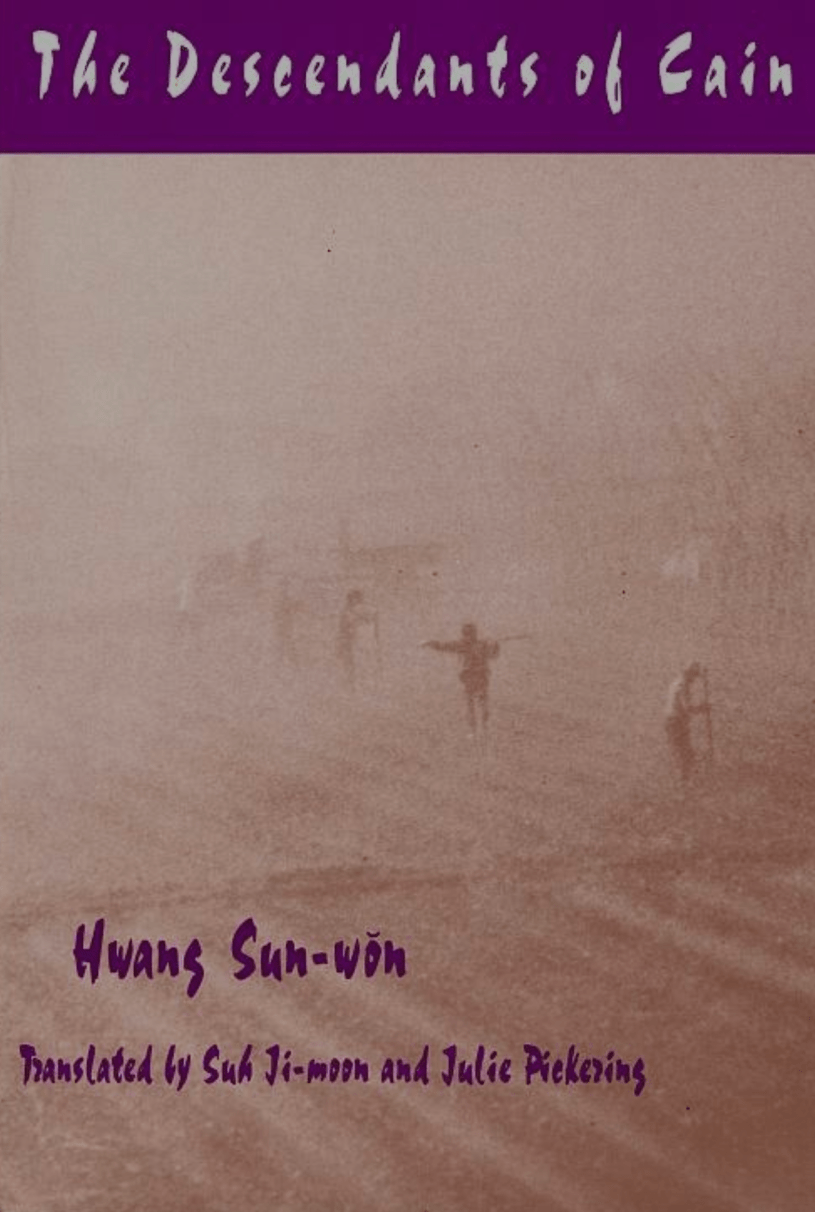
The Descendants of Cain
By Hwang Sun-won
Translated by Suh Ji-moon
1954, translated 1997
Routledge
Hwang sets The Descendants of Cain in the North after the liberation of Korea from the Japanese and during the early days of the arrival of communism on the peninsula. Hwang himself, the son of a northern landlord who fled the south to escape the violence, writes with the precision and sensibilities of a witness and a survivor. The language is simple, unadorned, and direct. Hwang presents the reader with pairs of memorable characters who embody representations of opposing ways of thinking and living and uses recurring imagery from the natural world to establish themes of both resilience and decay. Pak Hun, the male protagonist of the story, is the son of a landlord. A member of the yangban class, he and his family have suffered under colonial rule, yet not so badly as to prevent Hun from exercising his privilege to attend university in Japan. Returning to his hometown as a newly minted intellectual and fully aware of the increasingly violent communist activities in the area, he recognizes the danger to his family and himself, yet takes no action. Evidence of the brutal waves of “reform” set to engulf the region is writ large: a landlord has been murdered in his sleep, run through by a sickle; someone has shattered a memorial to a long-lived and well-beloved landlord; the night school where Hun teaches is shut down, and a Communist agent wearing a dog fur coat and surrounded by rough-looking bodyguards is interrogating villagers. Hun is disappointed to learn his father’s long-time estate agent has turned evidence against him. He also realizes the estate agent’s son is tailing him wherever he goes. To further complicate matters, for the last three years, Pak Hun has lived under the same roof with Ojaknyo, the daughter of the estate agent, who works as his maid. Though she is widowed and he is married, the two are engaged in a chaste but simmering romance, pure and restrained to the point of torment. Nevertheless, their supposed sexual relationship is treated as the town’s open secret. Worse, Ojaknyo’s husband, who disappeared while fighting the Japanese, returns to reclaim his wife and murder Pak Hun. As the reform movement continues to escalate and long-established orders are overturned, citizens become increasingly desperate, and the circle tightens around our passive hero and his devoted Ojaknyo. The Descendants of Cain, the tale of a fratricidal and perhaps cursed people, is one of the shortest of Hwang Sun-won’s books. Hwang keeps the tension taut until the very end, capturing the often deadly indecision of human beings beset by events so powerful and so seemingly inevitable that they overwhelm their very instincts for survival.
“Hun placed the bundle of land deeds on the stone altar in front of the grave. He untied the string and struck a match. The dry paper burst into flames, then sputtered out in a puff of blue smoke. The papers must be packed too tightly together, Hun thought. He picked up the first deed and touched the match to it. The paper caught fire immediately and shriveled to ashes. When the first deed was gone, he lit another, then another. Soon he was warming his hands by the fire.
Through the flickering blue flames he could see words: wet paddy, 4,500 p’yŏng,* dry field, 2,200 p’yŏng, irrigated paddy, 1,300 p’yŏng … They seemed as meaningless as the numbers on the scraps of paper he and his friends used to play bank with as children.
Next came the forest land, 3.4 hectares, and building site, 1,900 p’yŏng …
Hun soon lost interest in the numbers. He crumpled the rest of the deeds and placed them in the fire. It blazed up, and he dropped his father’s seal into the flames. Soon the papers were gone. Ashes danced on the breeze, and the ivory seal lay scorched and yellow on the blackened altar stone. Hun broke a twig from a pine tree and buried the seal, as if it were the bones of a cremated corpse.”

