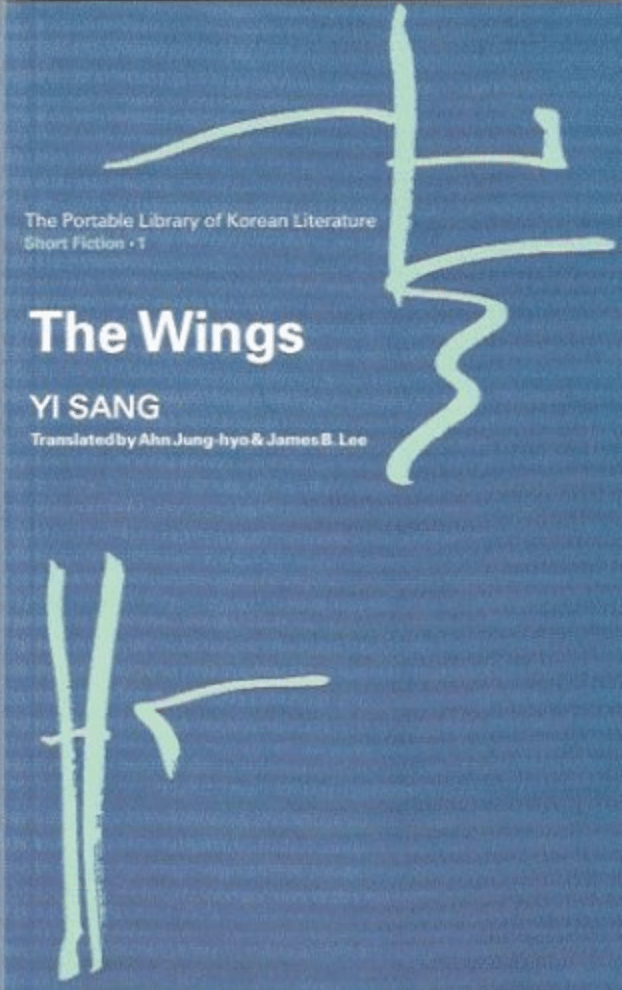
The Wings and Other Stories
By Yi Sang
Translated by Ahn Jung-ho and James B. Lee
1936, translated 2001
The Portable Library of Korean Literature
Yi Sang, born in 1910 as Kim Haegyung, lived but 27 years, dying of consumption in 1937. In that brief period, Yi made a profound impression on Korean literature. While pursuing a degree in architecture, he found himself in a sea of ideas and energy. Drawn to the work of European Modernists and the Surrealist movement, he began experimenting with poetry and commercial printing techniques, producing highly repetitive, bold prints featuring what appear to be random words, punctuation, and graphic styles. YI Sang, Collected Works, published by Wave in 2020, is a celebration of Yi’s poetry and features reproductions of the surviving poems; Jack Jung translated the work into English. He was very active in art circles and, in 1933, he opened the cafe Jebi, which became a meeting place for a generation of influential artists, the Guinhoe or League of Nine, which included writers such as Lee Tae-jun, Lee Moo-young, Kim Ki-rim, Lee Hyo-seok, Jung Ji-yong, and Yoo Chi-jin. The Wings and Other Stories include the iconic “The Wings,” as well as “Encounters and Departures,” and “Deathly Child.” “The Wings” is in part autobiographical, as the naive “I” in the story, like Yi, is enraptured with a beautiful Kisaeng, an entertainer who sells her services to men. The depressed and mentally fragile narrator isolates himself within his beloved’s room in a brothel, struggling to grasp the significance of where he is, where his muse might be, and what she might be doing that would inspire men to give her money. He wonders at the nature of money, peers through his mistress’s closet, and sniffs each and every one of the beauty products she uses to ply her trade. He is self-aware, painfully insecure, self-loathing, yet prone to flights of elegiac praise and indulgence for his femme fatale. Similar relationships are a recurring theme in the young artist’s work, reflecting his crushing loneliness and disconnectedness from others. Yi’s narrator looks boldly into the mirror only to see a self that is fractured, wounded in ways that cause him to mock himself and scream in agony. “The Wings” is a challenging read full of fragments and paradoxes, as well as moments of manic exhilaration. Part of the delight in Yi’s work is the push and pull the narrator inflicts upon the reader; is it any surprise that “The Wings” is so re-readable?
“I could not play with the magnifying glass; I could not sniff at the cosmetics. On these occasions, I pretended to be sorrowful. Then she would tip me a coin, a 50 jeon silver coin. I liked it. Since I did not know what to do with those coins, I used to throw them to the head of the bed until the silver coins formed a small pile. My wife saw the collection of coins one day and bought me a coffer-shaped savings box. After I put all the coins in the box, one by one, she locked the box and took the key away. I remember I continued dropping a coin every now and then, even after that. And I kept being lazy. When I found a trinket dangling like a pimple on her forehead, I understood why the savings box was lighter than before. I stopped paying attention to the box. I was too lazy to alert myself against such incidents.”

