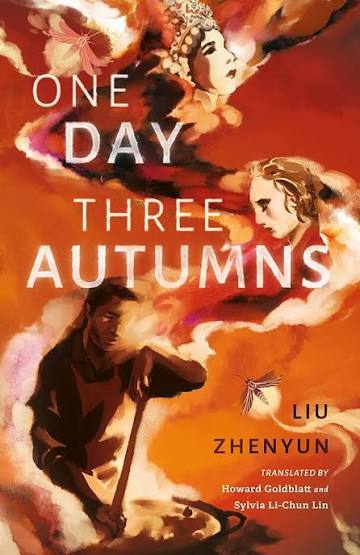
One Day Three Autumns
By Liu Zhenyun
Translated by Howard Goldblatt and Sylvia Li-Chun Lin
2021, translated 2023
Sinoist Books
Chinese opera, dreams, divination, and jokes are at the heart of Liu Zhenyun’s One Day Three Autumns. In his foreword, “Sixth Uncle’s Paintings,” Liu explains that when he was eight years old, his mother sent him out to audition for the local drama troupe, where his uncle made a living playing the sanxian, a three stringed lute, and painting scenery. The audition ended in disaster, the director observing that young Liu “had talent. The talent of sounding like a chicken being slaughtered. You would have to study hard to learn to sing that badly.” When the Cultural Revolution arrived in Yanjin, Sixth Uncle went on to work in a state-owned factory, and when that closed down, he maintained machinery in a mill. He stopped playing music, but he continued to paint. He’d sell celebratory couplets at holidays and paint his own fantastical versions of the local landscape as well as portraits of friends and street scenes where the banal and the supernatural intermingled. Sixth Uncle’s wife hated these paintings that never sold. Although both men agreed that they had “taken the wrong path” by embracing the way of the artist, they shared deep respect for the truths their stories told. Reuniting at New Year’s and Dragon Boat festivals, Sixth Uncle told stories of his friends and neighbors, comrades from the opera, and his interactions with fortune tellers, street sweepers, and demons. When he passed away, Liu committed to sharing Sixth Uncle’s visionary way of looking at the world and decided to bring his spirit, stories, and paintings to life. He presents us with a uniquely Yanjin story, a picaresque of the lives and loves of four members of an opera troupe who become famous for their performance of The Legend of White Snake. Central characters include Li Yansheng, Chen Changjie, and Yingtao, who played the role of the handsome scholar, the clever monk, and the white snake who takes the form of the seductive young woman. Not surprisingly, a musician and painter make up the fourth of a love quadrangle. When the couples leave the fantasy world of the stage, their lives remain influenced by the world of legend. Over the course of their lives, not only do they find shelter and aid from those who recognize them for their iconic roles, they discover they are playing out some form of the spirit they embodied on stage. Also, though no pagoda comes crashing down on the head of a gigantic white snake, fortunes shift rapidly, and supernatural forces threaten the living. In addition to using The Legend of White Snake and the idea of performance in his tale, Liu also includes a myth that explains the origin of a local geographical feature and the notorious love of laughter enjoyed by all the citizens of Yanjin–the deadpan humor and delight in irony that Liu so much admired in Sixth Uncle and his art.
“In addition to his skill in calculating fortunes from birth dates and bone structures, Old Dong was also able to message between realms. If someone wanted to speak to a dead relative or a dead relative had something to tell the living, when he received the precise birth dates and times of both the living and the dead and the date and time of the death, with a magic incantation he would pass on whatever was asked, ghostly words to the living and human words to the dead. He could even create living transmissions, allowing the living to see their deceased loved ones. As an acolyte of Celestial Master Zhao, for transmission between the living and the dead, he needed to pay homage to Zhao. When the Celestial Master appeared, he permitted the deceased to briefly occupy Old Dong’s body to meet with a living descendant. People who had recently lost their parents wanted to see them again to say things that had been left unsaid before the parting or might want to ask where they could find everyday things, something they could do thanks to Old Dong. ‘I never imagined we’d ever meet again,’ a man would sob as he held Dong’s hand to reach his parents. Or they might say, ‘Dad, where the devil did you put the bank book?’”

