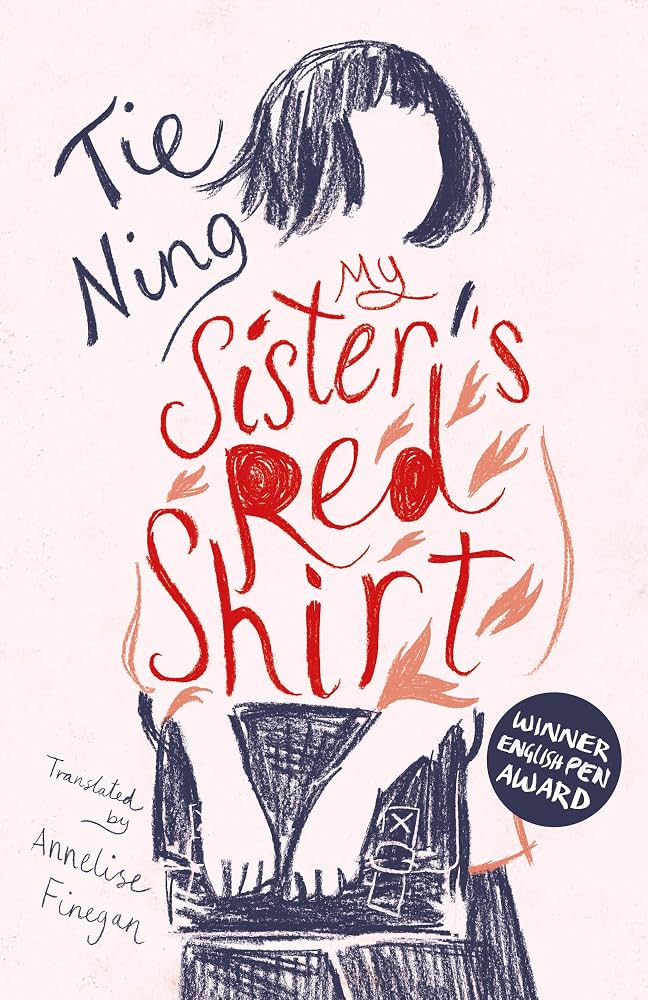
My Sister’s Red Shirt
By Tie Ning
Translated by Annelise Finnegan
2020, translated 2025
Sinoist Books
Tie Ming’s My Sister’s Red Shirt is an intimate, semi-fictional coming-of-age story set in the city of Pingyi during the Cultural Revolution. The narrator is Anjing, an educated, modest, and graceful woman in her twenties. She studies classical Chinese poetry and is employed as an editor at a city magazine, where she vets submissions that display technical assiduity and reinforce the values of the Communist Party. She is also involved in a love affair with a physics professor. Though the couple plans to wed, Anjing keeps the relationship hidden from her parents, quite certain that they will forbid her from marrying. Anjing expresses great dissatisfaction with the constant friction between her father and mother, a conflict that has cast a pall over her youth, since she can remember a time, before the Cultural Revolution, when her parents were in love. Yet her primary focus is on her sixteen-year-old sister, Anran. Anjing knows from experience that her sister, boyish, outspoken, opinionated, and fearless, is a target of negative attention and a lightning rod for conflict. Logical, highly intelligent, and unshakeable in her convictions, she runs afoul of her classmates and unnerves her teachers. Anjing wants to tamp down her sister’s very active revolutionary spirit, but she makes a fantastic error, believing that if she can persuade Anran to be more confident in her femininity, her sister will act and speak in a manner more restrained and politic. To that end, she takes Anran clothes shopping and buys her a buttonless shirt with a zipper down the back, cut from a fiery red rayon. Anjing falls in love with her new look. She truly feels more confident and thinks more frequently of a boy she admires. She is also very aware that the shirt sets her apart from her classmates, who wear standard collared shirts. Anran is the highest-scoring student in the class and yearns to be chosen as the “most excellent” student based on the “‘three excellences:’” health, studies, and morals.” Yet she will not temper her words or her essays at school, and she continues to wear the red shirt knowing that it rankles the very teacher who is in charge of deciding who shall receive the coveted award. Tie Ning’s novella presents an informal family portrait, a warm-toned snapshot of life during the Cultural Revolution, and a glimpse of the traditional and altogether new elements shaping the lives of ordinary Chinese women.
“Freckles and zits had never troubled Anran. The only blemish on her glowing, clean, chubby round face was a pair of birthmarks by her right ear lined up next to each other like a typed colon: perhaps this was why Anran loved to talk so much. Printed there, the colon also seemed to encourage people to talk to her. Every time you saw this colon, you couldn’t help saying something into her ear.
Yet she really didn’t like other people whispering into her ear. She preferred to speak openly with you from a certain distance and for you to speak directly to her. What else did she prefer? She liked music with a quick rhythm. She liked football and knew why Diego Maradona’s transfer to Spain ended in failure, and why Karl-Heinz Rummenigge turned down joining Juventus. She liked Huangmei Opera (oddly enough) and cold drinks, and could eat seven ice creams one after the other. She liked to swim, read short stories, collect stamps and practise acupuncture, liked knitting socks (at least knitting them halfway), playing leapfrog in gym class and the singer Momoe Yamaguchi.”

