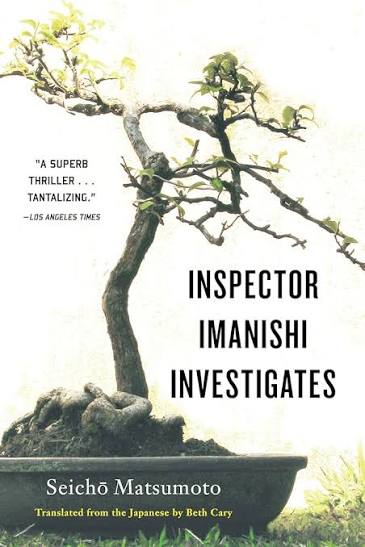
Inspector Imanishi Investigates
By Seicho Matsumoto
Translated by Beth Cary
1962, translated 1989
Soho Press/Soho Crime
Early on in Inspector Imanishi Investigates, Imanishi Eitaro observes that although he can hardly recall the details of the crimes that he has solved, he cannot stop thinking about the minutiae of the cases that have escaped his investigation. That is very much the issue with the murder of a faceless man found underneath a train in Kamata station in Tokyo. In Japanese, the original title of Investigator Imanishi Investigates is A Vessel of Sand, which hints at the months-long investigation and the elusive nature of the truth in a case that involves many feints, dead ends, and even more suspicious deaths. Just as the arc of the novel seems to sputter out, Imanishi discovers that the dead man was a good cop, a police officer from a rural town revered as a local hero. More determined than ever to find justice for the dead man, Imanishi faces an obstacle: every day, more new cases come flooding in. He continues to work on the case in the evenings and weekends and uses his and his wife’s savings to fund his many trips to the Tohoku region. A strength of the novel is that Seicho, instead of spotlighting his iconic haiku-writing, bonsai-tending public servant, allows secondary characters the opportunity to further the investigation. Yoshimura Hiroshi, a young detective who assists Imanishi-san, is portrayed as a youth who not only shares his mentor’s deep sense of duty but also possesses his own flair for sophisticated deduction. In addition, Yoshimura understands the modern world and a good deal of emerging industry, science, and Tokyo politics, topics which his older mentor finds he can no longer understand. Imanishi’s supportive wife and sharp-tongued sister also contribute to the final solution. Readers familiar with Edogawa Rampo will also be pleased to see the degree to which Seicho embeds contemporary technology in the investigation. For example, Inspector Imanishi, who has perhaps taken his wife to the movies once, tracks down two films released the week of the murder and persuades a theater owner to give him private screenings. He also takes a keen interest in the emerging electronic music scene. Patient readers who endure the slow cycle of starts and stops will be rewarded by one of the most interestingly structured and truly satisfying resolutions of the detective genre.
“‘Imanishi- san, this may sound strange, but I wonder how you feel about it,’ Yoshimura said, wolfing down his tempura over rice. ‘We go on various business trips like this. And afterward, rather than the scenery or problems I might have encountered, what I remember is the food. Our expense allowance is so small we can only afford rice with curry, or some meat on top of a bowl of rice, food you can get anywhere. Yet the flavoring is always different. It’s the taste of each location that I remember first.’
‘Is that so?’ Imanishi said, sipping his noodles. ‘After all, you’re young. I prefer to remember the scenery.’
Yoshimura said, his chopsticks stilled for a moment, ‘I hear that you write poetry. That’s why you focus on scenery. Will you add to your haiku collection on this trip?’
‘My poems aren’t any good.’ Imanishi laughed in self-deprecation.
‘By the way, what shall we do? Should we go to the police station right after we eat?’
‘Yes, let’s do that.’ ‘Isn’t it strange? We’re here because you happened to look at the supplement in your wife’s magazine. If it hadn’t been for that, I wouldn’t have seen this place. One’s life can be changed by a chance happening,’ Yoshimura said, pouring himself some tea. He’d polished off his bowl of rice, leaving not a single grain behind.”

