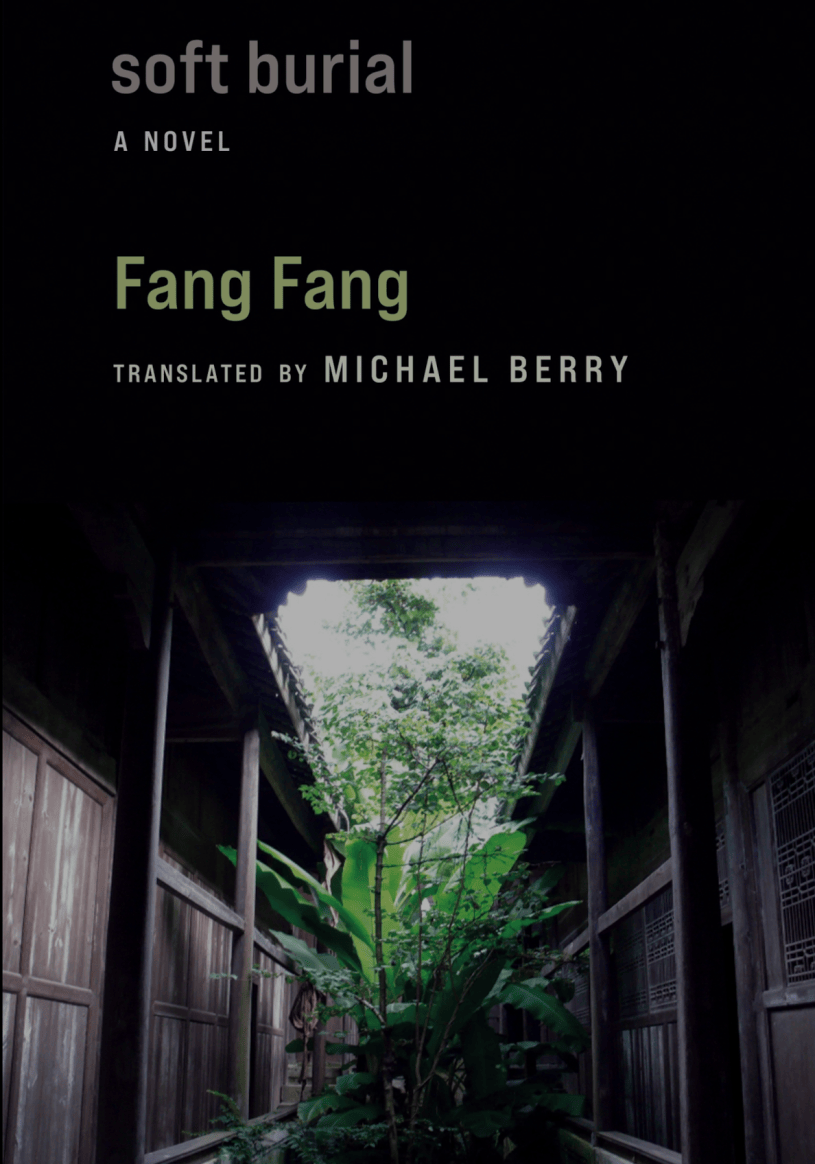
Soft Burial
By Fang Fang
Translated by Michael Berry
2016, translated 2025
Columbia University Press
Weatherhead Books on Asia
Fang Fang, a highly accomplished, influential, and well-respected Chinese author, ran afoul of the Chinese government when she began blogging about her experiences while under quarantine in Wuhan during the COVID-19 crisis of 2020. Her publication of these writings, Wuhan Diary, translated by Michael Berry, was banned in China. Within a few years, she discovered that her previous works had become harder to find. One of the texts to experience this disappearance was her Soft Burial, an historical novel set in the remote regions of Wuhan during Mao’s Labor Reform Movement (1949-1976). Published in 2016, the story begins with a familiar trope in modern Chinese literature: the return of a son of the city to care for an elderly parent or grandparent in the country. Qingling is the filial son. Now a successful architect, he was raised in Wuhan by his father, a doctor, and his mother, Daiyun. When Qingling’s father passed away, his mother insisted on living on her own in the family home. Aware of his mother’s steady decline in health and the onset of dementia, the filial son builds a modern home where the two can live, and he can provide her with care. The move to the new home creates an unexpectedly fierce conflict and leads to an increase in his mother’s fugue-like states. He catches her speaking as if she is somewhere in her past, speaking alternately in the voice of a young girl of privilege and from a place of visceral horror. Finally, she screams out the words “soft burial” before entering a coma-like state where she can neither speak nor move. Hoping to relieve his mother’s suffering, Qingling decides he must use the enigmatic statements of his mother’s final utterances to find the source of her trauma. He begins by searching his father’s diary and family letters, where he learns that his mother was once a patient of his father. By some miracle, she had washed ashore in the flooded village river, naked and unconscious. When she awoke, she had no memory of who she was or where she was from. Reading the diaries, he learns what little his father learned about his mother’s origins. Confronted by his father’s certainty that no one will ever know who his mother was, where she came from, and what caused her to be found in the river, Qingling sets his investigation aside. But soon enough, new clues rise from the forests and mountains of Wuhan, beckoning him to pursue the faintest of trails. When an old friend contacts him about a new client who is looking for an architect who can design a building using the vernacular architecture of Wuhan, they set off to explore a remote compound for Qingling to study. Their investigation is a goldmine of architectural inspiration and was certainly a warlord’s palace, fort, and trading hub. Over the months and years, Qingling works on his twin projects, designing a building and learning about his mother’s past, and in the process, discovers links between his mother, the compound, and another site that is undergoing archaeological investigation. The novel is challenging. Fang tells her story using multiple perspectives, various timelines, and complex flashbacks. At times, I was confused about when and where I was in the lives of Qingling’s mother and father, or who was speaking. Yet staying the course is well worth it, as the stories that emerge from the past are, in the end, beautiful. In her afterword to her novel, Fang Fang reveals that a “soft burial” occurs when a dead person is interred directly in the ground, with neither a coffin nor a grave marker. And finally, Fang explains that she uses the term metaphorically to reveal that though history can be likewise buried in shallow and nameless graves, it will never escape discovery.
“Her gaze often locks onto a particular object, as if she is lost in deep thought, but sometimes it simply looks as if she is just staring into space. Occasionally, when this happens, pedestrians passing by will stop out of curiosity and ask, ‘Hey Granny, you okay? You got something on your mind?’
During those moments she looks dazed and usually stares back blankly at the passerby, mumbling some indistinct words. Not even she realizes what she is saying. In those moments even she herself wouldn’t be able to explain what was going through her mind. It just felt as if all kinds of queer things were tugging at her memory, trying to leap out of her head. Those were things she had spent a lifetime trying to avoid. She tried to resist them. Her resistance was like a thick, tight net, enveloping the army of demons that were constantly trying to break out. For her entire life she had carried that net with her, always ready to face down those demons.
When her husband was still alive, he would occasionally urge her to think hard and maybe she would be able to figure out what was going on inside her; perhaps then she could find some kind of inner peace. She took her husband’s advice, and there were many times when she tried so hard to find a quiet place inside herself and bring those memories forth. But whenever she tried, she would suddenly be struck by some terrible sensation: It felt as if her entire body were being pierced by countless needles. It was as if her body were being ripped apart from the inside. During those moments the pain and exhaustion made her feel as if she could barely breathe.”

