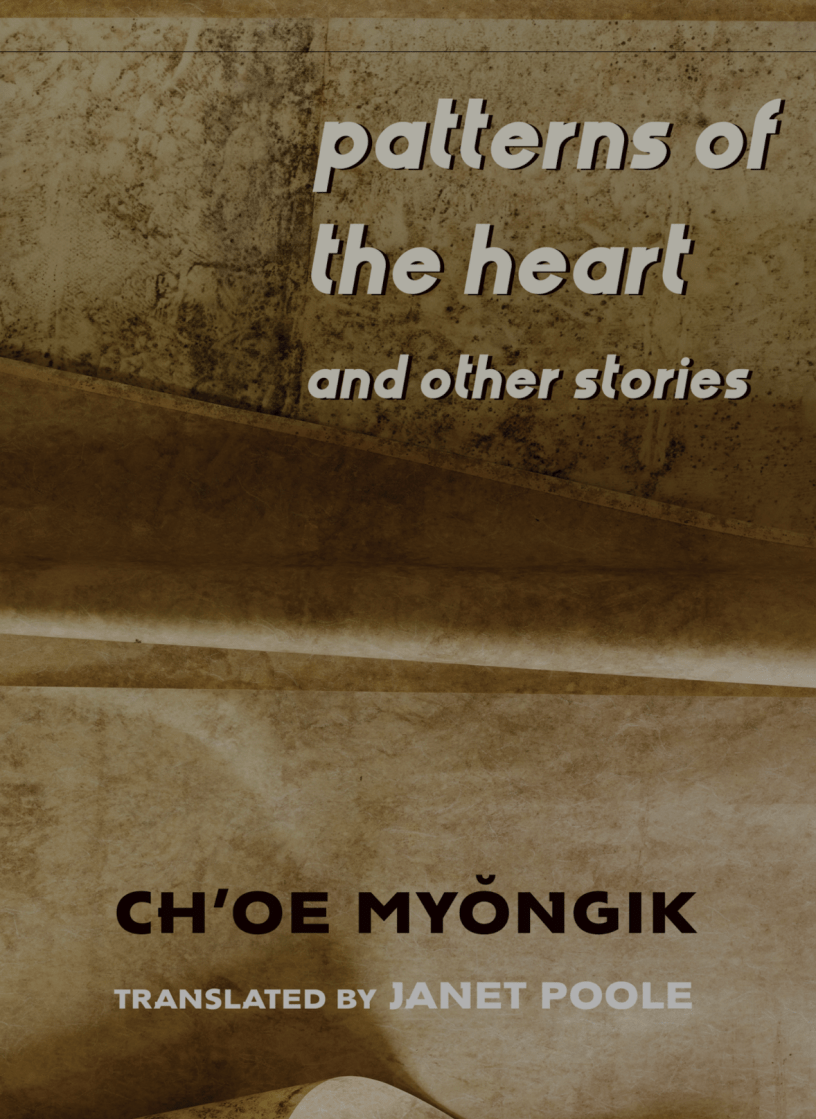
Patterns of the Heart and Other Stories
By Ch’oe Myŏngik
Translated by Janet Poole
1930-1952, translated 2024
Columbia University Press
Weatherhead Books on Asia
Ch’oe Myŏngik was born and raised in Pyongyang under the Japanese Occupation. From the very start of his writing career, Ch’oe was devoted to the city of his birth and working toward a free and independent Korean nation. He allied himself with the North and passionately embraced the regime of Kim Il-sung. Ch’oe published his first works in leftist magazines in the 1920s, and earned his first widespread recognition in 1936 with the short story, “Walking in the Rain,” which is the first entry in this collection. Moody and focused on a tentative relationship between two men employed in the arts, a writer and a photographer. Their conversation reveals the desperation each feels to bring in work and put money on the table, while the spirit of the nation lives on in the form of bats that fly over the city at night, or as a snake-like god upsetting tiles in the crumbling West Gate. In the title story, “Patterns of the Heart,” Ch’oe introduces us to the world of a widower, a painter, who is reluctant to remarry because he is still in love with his deceased wife and wants to avoid bringing a new woman into the life of his teenage daughter. Nevertheless, he takes up with one of his models, a beauty who is reputed to have associated with Korean freedom fighters in Japanese universities. That diversion ends, but a year later, while in Manchuria, the painter meets his muse a second time. Now she is with her once heroic lover. Once a tiger of Korean freedom, he and his erstwhile lover, now his nurse, are addicted to opium. Some of the best pieces are of the final days of the Second Sino-Japanese War and the Liberation of Korea. For example, in “The Barley Hump,” Ch’oe uses the agricultural metaphor of the barley hump to bring to life the long suffering of the Korean people. He models his narrator, Sangjin, after himself. Sangjin is a writer whose work was suppressed because he wrote in Korean. Slightly better off than most, he acts on a tip and invests in land that can be bought cheaply, hoping that the Japanese will be unable to hold the peninsula for another three years. Yet the Japanese do hold on, and each early spring, Sangjin and the local peasants suffer starvation when the only food to eat is barley. Their pain is exacerbated by increasingly high agricultural tributes by the Japanese as well as the their conscription of young men to fight against the forces of Chiang Kai-shek and the great Kim Il-sung, who Sangjin envisions as “a fighting hero lighting a beacon for the liberation of their homeland on behalf of all his compatriots on top of Mount Paektu, that ancient Korean peak and treasure trove of magnificent ancestral legend.” Ch’oe’s stories of the 1950s are increasingly propagandistic in nature, featuring young freedom fighters who have been captured by Americans or their puppets, the National Defense Force of South Korea. Not surprisingly, in “The Engineer,” Chō’oe portrays the Americans as murderous and inhuman thugs, motivated by greed and bloodlust. In “Young Kwōn Tongsu,” a resident of Pyongyang makes the mistake of visiting the Pyongyang neighborhood of his youth that has been turned to rubble by US ordinance. He is captured by a collaborator and a group of military police who beat him almost to death before imprisoning him with other “red bastards.” Will he be able to escape? For those interested in what was happening in Pyongyang and the influence of communism from the 1930s to the 1950s, Patterns of the Heart and Other Stories is essential reading.
“Once another brooding hen had been counted in, Kŭmnyŏ found herself wearing a silver ring, just like Yugami.
The women of the village referred to the two girls as “the twins,” because the two of them would meet up at the well to draw water wearing exactly the same jackets and skirts and identical silver rings on their fingers. If either girl were to appear alone, the other women would playfully ask the whereabouts of her twin.
The two bridegrooms, on the other hand, could hardly have differed more.
Yugami’s husband—the one who had secretly sent the silver ring—was a strapping young man of nearly thirty years of age. At the wedding ceremony he was fully drunk before the main dining table had even been cleared away and had used a cigarette to set fire to the paper showing the hour and date of his birth, which the schoolchildren had presented to him when they came to tidy up.
Kŭmnyŏ’s husband was a couple of years younger than her and no more than a child. When the dining table was cleared away at their ceremony he had kicked up a fuss, crying and insisting he return home with his father, who had accompanied him to Kŭmnyŏ’s house.
Consequently the villagers had labeled Yugami’s husband a drunkard and Kŭmnyŏ’s new groom a crybaby.
Once they were married to such different bridegrooms, Yugami started to avert her gaze, her head bent low as if bowing under the weight of her newly raised hairstyle, while Kŭmnyŏ carried on much as before, her red hair ribbons fluttering in the wind like a chick’s newly sprouted cockscomb.” -from “Spring on the New Road”

