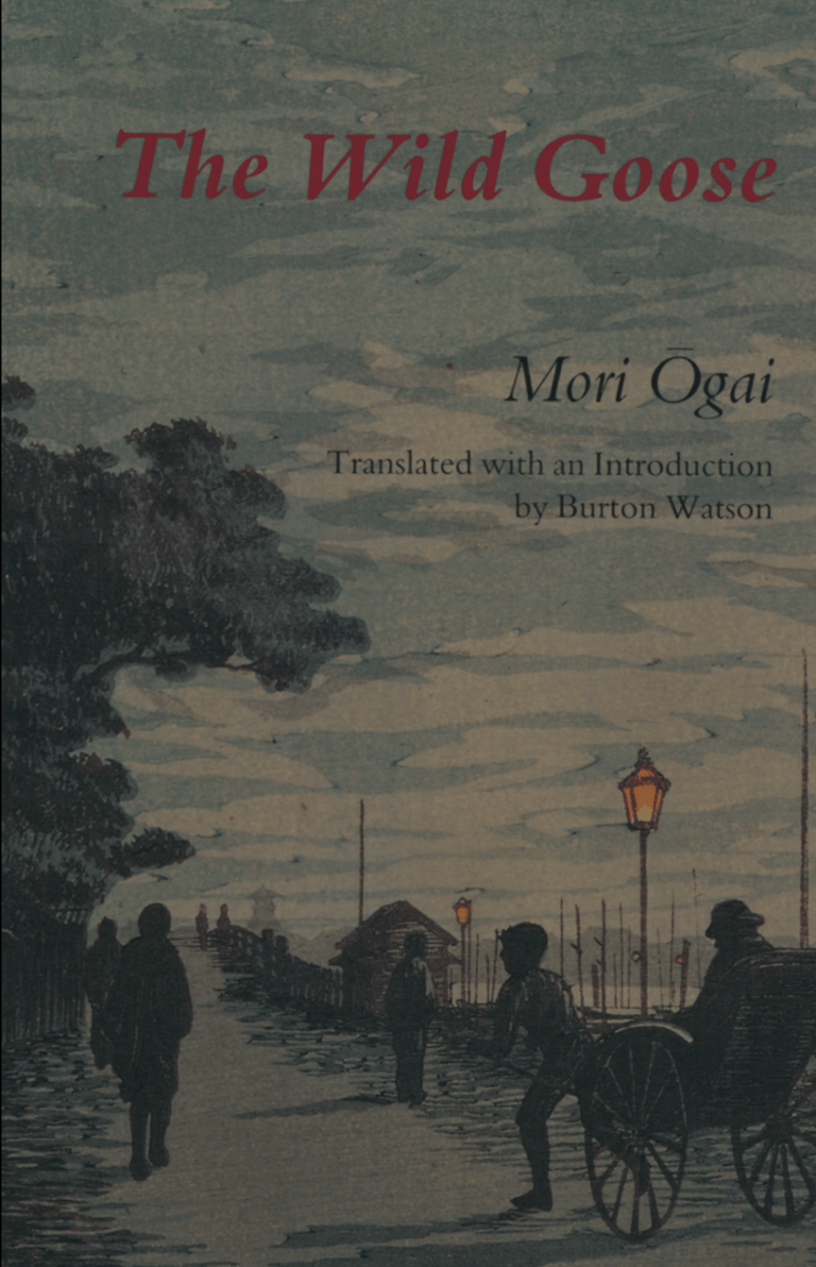
The Wild Goose/The Wild Geese
By Mori Agai
Translated by Burton Watson
1911-1913 , translated 1995
The University of Michigan
The Wild Goose, also known as The Wild Geese, is a historical novel, written and published in serial form between 1911 and 1913. Mori sets the action in 1880 Tokyo, capturing the significant cultural and societal changes that occurred as Japan passed from the Edo to the Meiji periods. The narrator is a middle-aged doctor reflecting on his days as a student in Tokyo University’s medical school, when he shared a room in a boarding house with Okada, a morally correct, respected, and affable scholar one year his junior. His reverie inspires him to tell the story of Okada’s first love. Okada and the narrator share a love of exploring used book stores, and they are both prolific walkers. In his solitary wanderings, Okada catches the eye of a young woman who lives alone in a small home in a lower-class neighborhood. A glance reveals she is a kept woman, and in time, he learns of her sad tale. She is Otana. She is being raised by a father addicted to gambling. A neighborhood police officer married her, but within three months, he absconded after Otana discovered he already had a wife and child. Deeply shamed, Otana vows to throw herself down a well, but a man named Suezo–who is a moneylender and a porter at the medical school– intervenes and offers her father an opportunity: sell Otana to him. In return, Suezo will provide food, shelter, and protection to Otana and her father. Not surprisingly, the privileged Okada falls for the beautiful Otana, and they share a romantic dream of fleeing Tokyo to begin a new life together.
Mori portrays the philandering police officer, the oily moneylender, and Otana’s shallow and self-serving father as masculine monsters, embodying the collapse of the social order. His rendering of Okada as a white knight is a little too on the nose, though he does not hold back on his final judgment of the character. The Wild Goose is significant as it is one of the first Japanese novels to fully portray the lives of the fallen, the demimonde, alongside the lives of the entitled. The highlight is Mori’s sensitive rendering of the two women in the novel: Otana and Otsune, the moneylender’s wife.
“Otama decided that she must settle on one of two alternatives, either speak to Okada herself or send Ume with a message. The evenings were growing so cool that it was hardly possible to leave the paper panels of the window open. Up to now, the garden had been swept only once in the morning, but after the recent incident with the broom, Ume had taken to sweeping it again in the evening, so Otama could no longer use that as an excuse to be outside. She had tried going to the public bath at a later hour, hoping she would run into Okada along the way. But the distance to the bath at the foot of the slope was too short, and she never succeeded in doing so. And as for sending Ume with a message, the longer she put that off, the more contrived it would seem.
Then she tried for a time looking at it this way, hoping to persuade herself it was all right to take no action at all. I have let all this time go by without thanking Mr. Okada, she reminded herself. In failing to express thanks where thanks were surely due, I have shown that I am willing to be indebted to him. And he must surely realize that I do in fact feel indebted to him. So, rather than expressing my thanks in a clumsy manner, it is perhaps better to leave things as they are.
Yet Otama longed to use this very indebtedness as a means to get to know Okada better as soon as possible. Only she could not hit on the exact procedure to follow, and this was a source of secret anxiety to her each day.”

