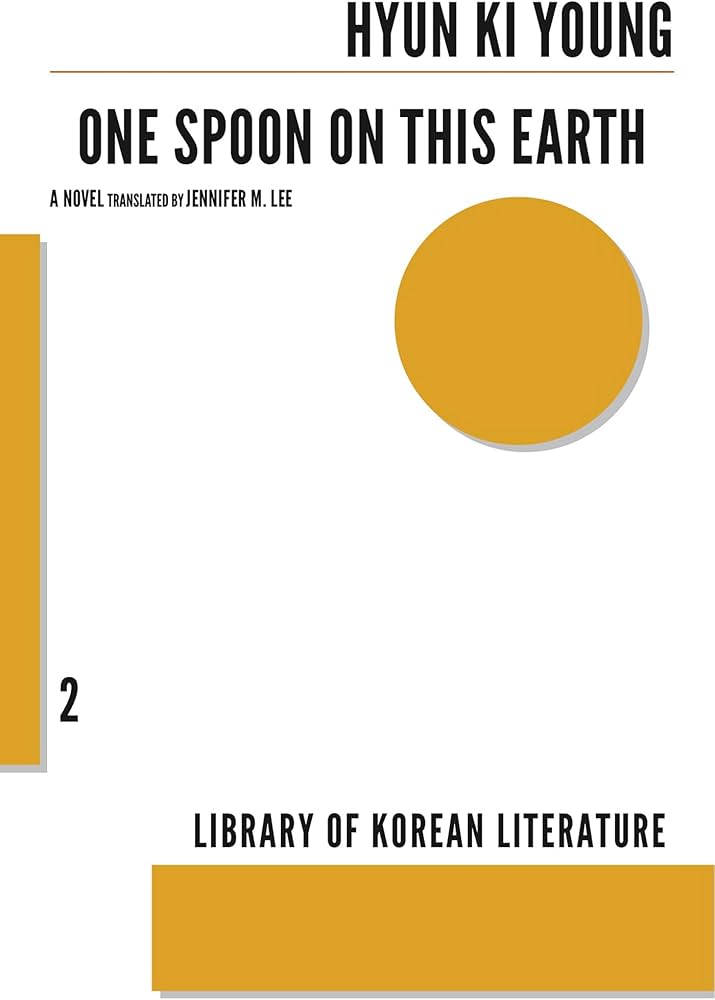
One Spoon on this Earth
By Hyun Ki-young
Translated by Jennifer M. Lee
1999, translated 2013
Dalkey Archive Press
Hyun Ki-young was a survivor of the 3 April Jeju Uprising and an acknowledged expert on the 20th century history of the island. He was the director of the Committee for the Investigation of the 3 April Jeju Uprising and the President of the Jeju Institute for the Investigation of Social Problems. He published his first novella, Sun’i Samch-on or Aunt Sun’i, in 1978, violating the nation’s ban on speaking or writing on the topic of the massacre, for which he was imprisoned and tortured for three days. One Spoon on this Earth is a much larger project, a semi-autobiographical novel that runs to 330 pages and focuses on his childhood memories up to age 14. Hyun confesses to the reader that as he enters his later years, he thinks more and more about his life before, during, and after the massacre, acknowledging that since his father’s death, he spends more time seeking lost memories of his youth. With his father gone, he feels “closer to death,” a state of being that allows him to access finer-grained, more subtle and ephemeral experiences. Hyun augments his childhood recollection of the massacre that began in 1947 and ended with the outbreak of the Korean War with his masterful knowledge of every military, police, civilian, and communist action. Hyun’s memories of the uprising recreate the horror and trauma he experienced as a sickly, starving six-year-old boy; his historical reporting on what was happening politically provides context and scale. More so than in other novels about the Jeju massacres, he exposes the role Americans played in the campaign to cleanse the island of any communist influence. Perhaps 20% of the novel focuses directly on the massacres. He writes extensively on the impact of poverty on his life. Growing up in rural Jeju during a time of many poor harvests and drought, he reports suffering illness after illness and experiencing accidents while working in the fields and playing unsupervised on the rocky coast. He almost died at least twice, and a particularly bad fever caused him to lose hearing in one ear. His family’s poverty was complicated by his father, who likely suffered from mental illness. Even before the chaos of the massacres, Hyun’s father was unable to hold a job. Disappearing for weeks and months at a time, he would drift back into his family’s life and then go missing once again. At the height of the massacres, He was shipped off the island, and when he resurfaced a year later, he was a private in the ROK; a few years after that, he sent his family a photograph of himself as a sergeant in the Military Police. Hyun pairs descriptions of his unreliable father with his mother, a woman who eats her suffering like food. She works heroically, but her relentless commitment to working leaves her no time for her son’s emotional needs. As he matures, Hyun shares the birth of his interest in school and his passion for literature, as well as his interest in the opposite sex. Throughout, he reflects on the depression that haunts his every moment, even from his earliest days, attributing his self-loathing and self-destructive acts to childhood illnesses and starvation, while also acknowledging that his family’s troubles left him with significant trauma. Yet, a recurring theme is the joy Hyun takes in exploring the natural world of the island. Whether playing in groups or wandering in isolation, the island’s streams and volcanic, rocky shore provide him with comfort, food, and an opportunity to wash away the filth of his life, ease his wounds, and restore his spirit.
“There was another interesting attraction besides the judo gym. By the entrance to the building, there was a shoe repairman who sat pathetically in one corner. He was called Blackie. He was from my village. When the people from Nohyongri left their burning homes and were placed in the concentration camp at the beach. He pointed out and picked out villagers among the crowd, sending them to their deaths. He had his trapper hat on and wore a mask to cover his face.
When I heard a rumor that the person who had a deadly finger gun, the one who pointed at and turned his own people in, was fixing shoes at the front gate of the police station, I was scared and nervous about seeing him. There was a group of us who went there, and one of them was my cousin. I remember he was so scared that he could not go near him, so he hid behind me. My cousin lost his father, grandmother, and uncle on the same day during the Cheju Massacre.
The shoe repairman was called Kurumbo, meaning Blackie in Japanese, and his complexion, just like his nickname, was as dark as charcoal. He resembled a dark angel of the underworld. I could not believe that the notorious and ferocious Blackie had degenerated into a mere shoe repairman…”

