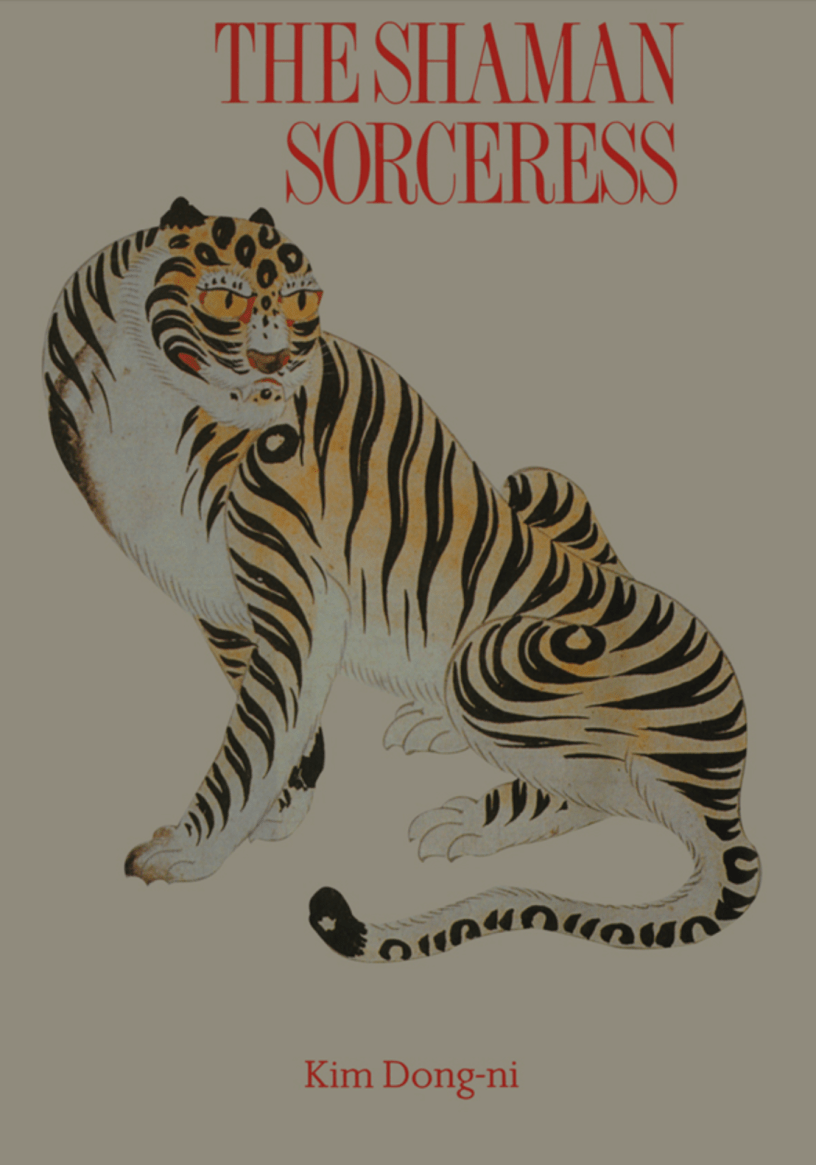
The Shaman Sorceress
By Kim Dong-ni
Translated byHyun Song Shin and Eugene Chung
1989, translated 2018
Routledge
Kim Dong-ni grew up under Japanese rule. Though his family was poor, one of his older brothers managed to complete his education as a philosopher and scholar of the Chinese classics. He had a powerful influence on Kim Dong-ni, feeding his love for literature by directing him to novels, poetry, and essays. When his family could no longer afford to send him to school, he dropped out, yet he continued to study literature and write poetry. After publishing his first poem, he committed to a life of writing poetry, short stories, novels, and essays. The Shaman Sorceress is a novelization of a short story he wrote in 1936, “The Portrait of a Shaman.” Throughout his career, Kim sought to preserve the ideals, practices, and beliefs of the Korean people while the country was under the existential pressures of colonization, communism, and Christianity. The story is set in a derelict house outside the precincts of an impoverished rural village. The house is owned by Eulhwa, a shaman, and her mute and deaf teenage daughter, Wolhie. Kim reveals that, as a shaman, Eulhwa is a taboo figure. Though she is regarded as an outcast, people from her neighborhood and surrounding villages seek her services as a powerful exorcist who never asks for a fee. Kim reveals the tragic origin story of Eulhwa and portrays how she learned to become an intermediary between gods and men. The Shaman Sorceress is a rich source for anyone interested in learning about Korean shamanism. Kim describes several rituals, including the dancing and use of gongs, bells, mirrors, and knives, as well as the integral role of music and painting. He includes several pages-long incantations, in which Eulhwa battles demons and ghosts for the lives of the country people. Everything changes when her son returns. Unable to feed him and fearing that his identity as the child of a shaman would destroy his life, she abandoned him at a Buddhist temple. Twenty years later, he returns to his family as an evangelizing Christian, determined to save the souls of his mother and sister. At times, the son displays awe in the presence of his mother, overcome by the power she wields over a community that clearly regards her as a profoundly spiritual person and a protectress who can call back people even from the brink of death. The Shaman Sorceress portrays the conflict of indigenous Korean religion against the inevitable influx of Christianity. No doubt Kim would be interested in seeing the continued persistence of Korean shamanism on the peninsula and its status as an Intangible Cultural Heritage.
“When Eulhwa appeared before the ceremonial table carrying Pakji’s fan, she caught the eyes of everyone there who turned in amazement. There was, of course, the relief that the ceremony could be seen to its conclusion, but more than this, there were the feelings of astonishment and admiration for this charming sorceress, barely twenty years old, with her flower-like face and well formed body captivating everyone with her bewitching movements.
Eulhwa at length began the incantation.
‘Look at that envoy from the Afterworld. He has not been able to get what he came for.”’
Eulhwa enthralled the whole audience in seconds with her soft, affectionate voice. It had a strange power which seemed able to penetrate deep into the listener’s flesh. She continued.
‘Looking to my right I can see my parents and my brothers and sisters. But who can go instead of me? Looking to my left there are my wife and my many children. But who can go instead of me? Looking down I can see my relations. But who cares about me anyway?
As she mixed in a little humour speeding up the tempo of the incantation a little, the audience gave a burst of laughter as they were captivated anew. She thus made the audience laugh in the beckoning rite, but later in the banishment ceremony she drowned everyone in their own tears. People there were full of praise saying, ‘I’ve never seen a shaman like that,’ or ‘I can’t tell if she’s a sorceress or an angel.’”

