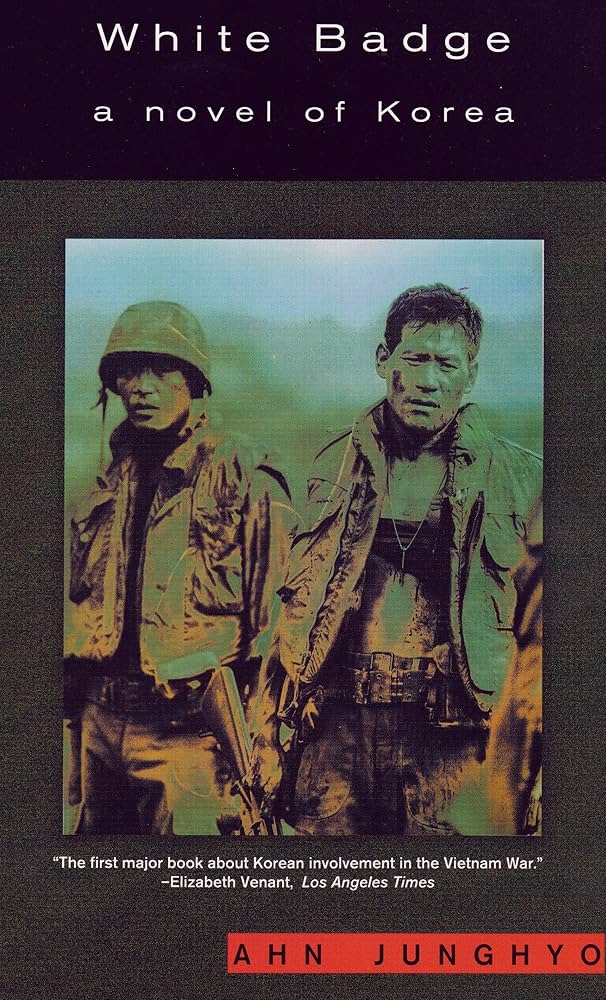
White Badge, A Novel of Korea
By Ahn Jung Hyo
Translated by Ahn Jung Hyo
1983, translated 1989
Soho Press
Ahn Jung Hyo studied literature in college, worked for several years as a journalist, and then joined the staff of a publishing house. He was a prolific translator, translating 150 novels into Korean. He published four novels. White Badge is based on his experiences while serving as a private soldier in the White Horse 9th ROK Army infantry Division. Korea sent 300,000 men to fight in Vietnam to strengthen its alliance with the US, secure economic aid, and fight communism. While acknowledging these motivations, he admits that he and his peers volunteered to fight abroad because they were earning about four dollars a month for their compulsory military service in Korea, pulling pointless guard duty and running errands and acting as servants for the higher ranks, while the Americans were willing to pay them 40 dollars a month for just a year of service. Ahn begins the story when the narrator is 38 years old and working at a publishing house. Though the war is thirteen years in the past, he is still haunted by his experiences fighting the Viet Cong. In Part 1, his marriage is struggling, he feels he is contributing nothing at work, and he is more and more certain that one of the soldiers he served with is stalking him. In Part 2, the narrator takes us deep into the year he spent in Vietnam, describing long periods of inactivity and boredom, a relationship with a local woman and her son, and negotiations with Vietnamese villagers. Many of the narrator’s comrades are from the Korean countryside. Having survived the Korean War, they relish their new lives in Vietnam, where they always have food to eat and they are earning more money than they ever imagined. A college graduate, the narrator stands out because he is fluent in English and French, so he is often called in to assist with translating when they encounter prisoners or village headmen. As the months pass, the White Horse men are sent out to forward listening posts, where they find only buffalo. Some wonder out loud where the enemy could possibly be; one suggests that the war is a big scam. Many times. The narrator is reminded of his own childhood in Korea, especially when he sees children picking through GI trash for food or hustling to earn money or candy from American soldiers. When contact with the enemy finally comes, Ahn portrays the savagery of the combatants with shocking honesty. His narrator wishes at one point that he were a soldier fighting hundreds of years in the past, defending his Korean homeland with a sword and a spear, instead of fighting abroad for cash and using automatic rifles and hand grenades to reduce a stranger’s body to smoking meat and bone. Ahn’s narrator is no hero, nor are his comrades. When their final mission goes wrong, what they experience shatters their entire belief systems. The mood and tone are the darkest of the dark. How could they be otherwise? When it was released in 1983, White Badge was not particularly well received. Yet it became a successful film in 1992, and when the novel was re-released in 1993, White Badge earned genuine praise and gained a much larger audience. N.B: I read this novel as an E-book. Throughout, there were neither periods nor question marks. I could tell where a sentence ended by cuing on capital letters. I believe the text may have been scanned; one clue is that the device struggled with diphthongs like “ai” and “ei.” For example, “rain” appeared as “ram” throughout. Casual sexism and racism can also be found; there is not much good said about American or Vietnamese soldiers, but women of all countries and Black Americans are explicitly stereotyped.
“At school I used to zealously copy down lectures on the poetry of Dryden and Coleridge in those sunny classrooms. A year after graduation, I was hunting human beings. For several years after returning home from the war, I was racked by recollections of what I had gone through .Tens of times I lived again all those incidents engraved in my memory.
Why had I volunteered to go to the war in the first place? Perhaps I had been falsely impressed by the exaggerated concept of heroism in war. The overblown presentation of heroics in literature and movies. The romantic fantasy, even of death as a glorious act. Watching Richard Widmark in a war movie, I used to marvel and cheer in my heart at the tragic gore. I was trained to understand war through stories of someone else, someone else who eloquently persuaded me that war was a sublime moment in which heroic actors, men of action, displayed the most profound and admirable qualities. Or I might have gone to Indochina hoping I could prove, at least to myself, what kind of a man I was. How I would respond to war. They said the guerrilla warfare in Vietnam was no more than a children’s game compared with the war in our country thirty years earlier, and I cherished the dubious idea that there would not be any actual killing around me, us, anywhere. Killing simply did not exist in my imaginary war. In truth, I went to watch the war, not to fight it. And the war, in that strange land in the past, marred the present.”

