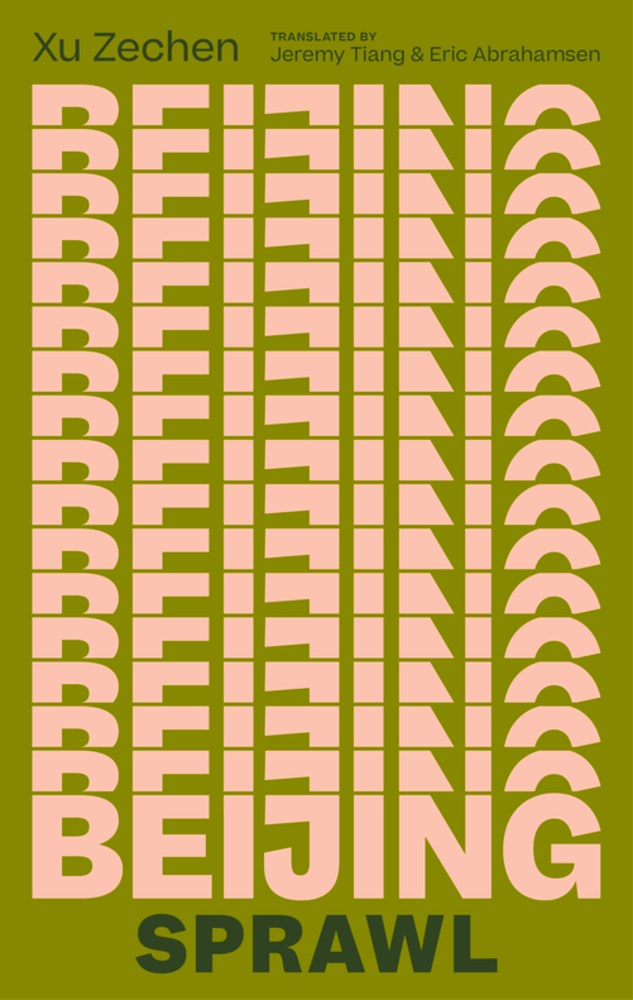
Beijing Sprawl,
By Xu Zechen
Translated by Eric Abrahamsen and Jeremy Tiang
2013, translated 2023
Two Lines Press
Xu Zechen writes about the Chinese men and women who leave the countryside to find work in Beijing. Their chances for success, even survival, are slim. They have few assets, limited skills, and little more than a high school education, if that. Lacking hukou or residence permits, these workers inhabit a legally gray world. They can find landlords to rent to them, but the quality of the rental property tends to be poor. Some lack heat and running water. The narrator, who is beset by debilitating anxiety and migraines, is seventeen-year-old Muyu, a high school dropout from Huajie who hitched his wagon to uncle Thirty Thou Hong. Hong sells fake IDs and hires Muyu and his four roommates to canvas the city by night, posting handbills, distributing business cards, even writing graffiti on walls, train and bus stations, and restaurants. They work most of the night, and when they finish, they climb up on the roof of their building to drink, play cards, and gaze out over the single story bungalows (pingfang) below them and the distant bright towers of Beijing. Xu presents us with nine vignettes that always include Muyu and anyone who happens to be sleeping in the two bunkbeds in their tiny room. Muyu and his coworkers reflect on the dead-end quality of their job, the tedium of the work, their homesickness, and their desire to find a woman who might marry them. Muyu discovers that running can stave off his migraines and limit the intensity and number of his nightmares, and it is not uncommon for him to up and leave his companions for longer and longer runs through the neighborhood and beyond. They encounter adventures and unexpected tragedies that strike like lightning. Xu describes the collective lives of his characters in familiar and engaging rhythms. Though their actions can be reprehensible, I found myself wishing I could join them on their roof for donkey burgers and duck necks, playing ace of spades, drinking beer, and regaling one another with secrets and dreams.
“Xinjian and the others got out and opened the last two bottles of beer while I held the light for Mingliang as he worked out what had gone wrong. As the beer cooled us off, we started feeling the chill. Mingliang fiddled with every part he could think of, but the car remained a pile of metal, even colder than we were. Quickly our main priority became getting warm, so Mingliang gave up and told us to collect dry grass, branches, and bricks from the side of the road. He pulled a little gas from the tank and lit the branches, and we baked the bricks. Around the time that both we and the bricks started to warm up, he suddenly slapped his forehead, reached behind the steering wheel (formerly from a Honda), fixed something, and the engine turned over.
“Goddamn it!” he yelled. “Wheels turn!” He showed us how to wrap the hot rocks in newspaper and hold them in our laps to keep warm—one of the survival tactics he’d learned as a truck driver. Restored to roaring life, the car leaped forward as if desperate to get out of there.
“Let’s name this thing!” said Baolai.
Xinjiang said, “Iron Horse!”
Miluo suggested, “Land Tiger!”
I said, “Stallion!”
“‘Stallion’ it is,” said Xian Mingliang. “Wheels keep turning!’”

