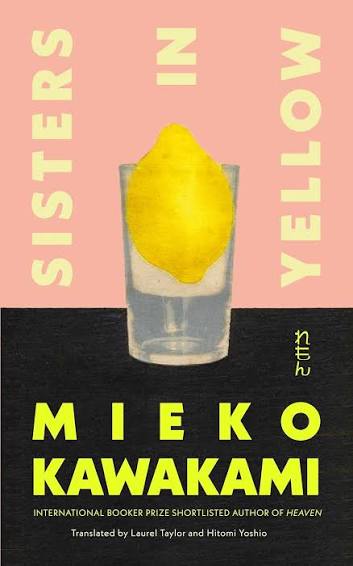
Sisters in Yellow
By Kawakami Mieko
Translated by Laurel Taylor and Hitomi Yoshio
2023, translated 2026
Knopf
Kawakami Mieko’s Sisters in Yellow takes us to the demi-monde of Japan in the 1990s, plunging us into a world that is unstable economically and morally. Pagers are giving way to the first cell phones and we are in the early days of a cashless economy when credit card security is in its infancy and organized crime is having a field day with fraud. Kawakami introduces us to a band of forgotten, lonely, and desperately naive and unparented teens. At the center of this circle is Hana, a fifteen-year-old latch-key girl. Her father is dead and her mother works “nightlife.” She is often away for weeks at time, returning to toss some cash into a can on the kitchen counter before departing. Hana pays all the bills and buys and cooks her own food. Her classmates taunt her for her uncut hair and tattered clothing, and parents forbid their children to associate with her. Hana’s loneliness and sense of being without purpose ends when one morning she wakes up to find a strange woman asleep on the futon next to her. She is Kimiko, a friend of her mother’s from “nightlife” who works from time to time at a local bar. With less than a suitcase, Kimiko moves in. Like a newly fledged bird, Hana imprints on Kimiko as a mother-figure almost instantly, awed by her life experience, companionship, and the warm routine she brings to Hana’s lonely existence. Hana quits school, works in a family restaurant, and then, through Kimiko’s connections, the two find themselves managing their own bar. There, Hana discovers other lost teenagers like herself, runaway girls, living at no fixed address, and never having more than a handful of dollars in their purses. She meets Ran, a seventeen-year-old whose job ss to lure men into a bar featuring female conversation, and Kotomi, a stunning creature who works as an escort. There is also a daughter of privilege bent on punishing her family by skipping school and crawling bars with a man in his thirties.
Though the bar is busy and they take pride in their work, they are always on a knife-edge between success and failure, and it is not long before their survival depends on the patronage of gangs of numbers runners, small fry yakuza, and loan sharks. For Kawakami’s characters, especially Hana, money is everything. Readers familiar with Kawakami’s novels Breasts and Eggs and All the Lovers in the Night, know that her lonely and isolated female characters identify themselves almost exclusively by their work; their commitment to their careers and saving consumes their thoughts. Likewise, Hana’s inner voice ruminates over her daily take, the sting of past financial setbacks, and the near ecstatic joy she feels when adding cash to a hidden shoebox–almost to the exclusion of anything else. For example, when the Hana invites her friends to move in with her, she reveals little about their activities, personalities, and social skills, instead remaining locked in her head, rehearsing “attacks” on department stores, trying to comprehend how the scams she is involved in actually work and how they might affect the stores and individuals she is exploiting, and tabulating her present and future earnings. From time to time, Hana’s mother wanders back into her life, as does a low- level yakuza who mentors her like an older brother. These characters, as well as Kimiko, whose life-essence seems to begin to drain away, are the only people who can pull her out of her obsessive thinking about the financial security of the people around her. As a reader, at times I felt trapped in the hero’s anxious, ever-calculating mind, and precisely aware of how physically and emotionally exhausting it is to be trapped in survival mode in a world where income has a chokehold on an individual’s senses of value and security.
“Yeah. People like Kimiko, you can make them do anything, do anything to them. No family, no connections to the normal world, no real ID. If they disappear all of a sudden, nobody cares. There are lots of folks like that working in the dark, and to some people, they’re just things. Things you can use. Because they’re so easy to get rid of, to sink. That’s what I mean.”

