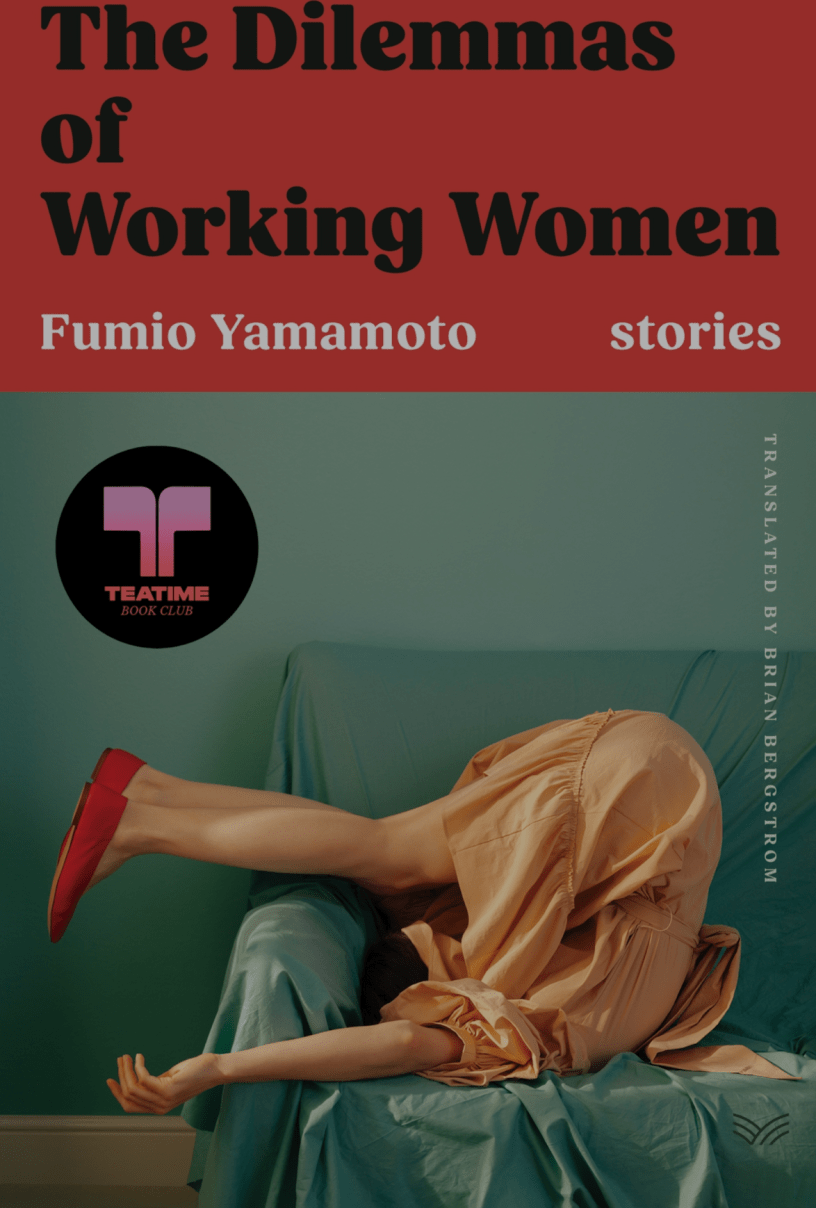
The Dilemmas of Working Women: Stories
By Yamamoto Fumio
Translated by Brian Bergstrom
(2000, translated 2025)
Harper Collins Via
Published in 2000, The Dilemmas of Working Women introduces us to five different single or divorced working women who are trying to navigate the post-crash economic instability of the 1990s.
Izumo’s husband divorced her two years ago, and since they ran a business together, she lost her job, too. She is a depressed 34-year-old woman living off her savings who has been occupying herself by knitting animals and many, many cute monsters of her own design. When a childhood friend asks Izumo out to lunch, she reminds her of her once hard-driving business sense, her demanding personality, and obsessive focus on the bottom line. Her friend acknowledges the pain of the divorce, but suggests that Izumo’s “recovery period” looks like she is running away from her life. In “Planarian,” Haruka is a young woman reeling from a diagnosis of breast cancer, the trauma of surgery, and the ongoing efforts to reconstruct her breast. Her response is to be open about her medical crisis, but her boyfriend and parents find her desire to share her experience inappropriate. While becoming more aware of her boyfriend’s controlling personality, Haruka takes a job working at a sweet shop and finds a friend in her boss, who is her age and also recovering from surgery. In “Here, Which is Nowhere,” a 43-year-old housewife and mother of two teenagers worries over the behavior of her children and their success in school. Her son is off at college, and increasingly, her daughter is out at all hours of the night. She arranges her schedule to be home to cook for them at breakfast and dinner, and works the night shift as a cashier in a “store that sold just about any non-perishable you could think of” while wearing hand-me-downs from her daughter. In “Dilemmas of Working Women,” 25-year-old Mito is startled when her long-time boyfriend proposes to her. Their relationship has become a routine. She is more aware of his ability to bend her to his will, and his pursuit of a PhD, while once a positive character trait, now seems a liability. In the final tale, “A Tomorrow Full of Love,” Yamamoto flips the script, giving us a tough-skinned male narrator. Thirty-six-year-old Majima is the owner of an izakaya. He’s been single for years, but recently he began secretly seeing one of the regular women who visit the bar. She lives in his house, but he is trying to keep their relationship a secret. The woman, Sumie, is very much a mystery. Majima imagines she is in her late teens or early 20s, and does not know how she makes her money, though he allows her to tell fortunes at the back of the bar in exchange for food and drinks. Yamamoto’s heroines are difficult. While they can’t quite articulate the issues or find the nerve to make a change, they are unhappy and stuck in their relationships. Some reject work, which is almost unthinkable in Japanese society, while others make work their identity. The characters are complex, funny, and even irritating, but all make a mark.
“We may be country folk, but we own several apartment buildings, which gives us more than enough to get by. We plan to leave them to our son, so there’s really no reason for you to worry about money.”
Asaoka-kun’s mother said this with her back turned to me. I knew it already, but now I felt it in my bones—this was where it all came from, the money he used to treat me to my birthday dinner, to buy me a love ring, to go visit a professional whenever he had the urge. But was I really so different? I lived in my father’s house, I’d gone to school on his dime—even the money I used on my little dates with Asaoka-kun, if you traced it back to its ultimate source, came from him.
“Excuse me,” I said. She’d finally found the kerosene, and now she stood up, the red plastic container in her hand. It was my turn to apologize.
“I’m very sorry, but can I ask you to leave now?”

