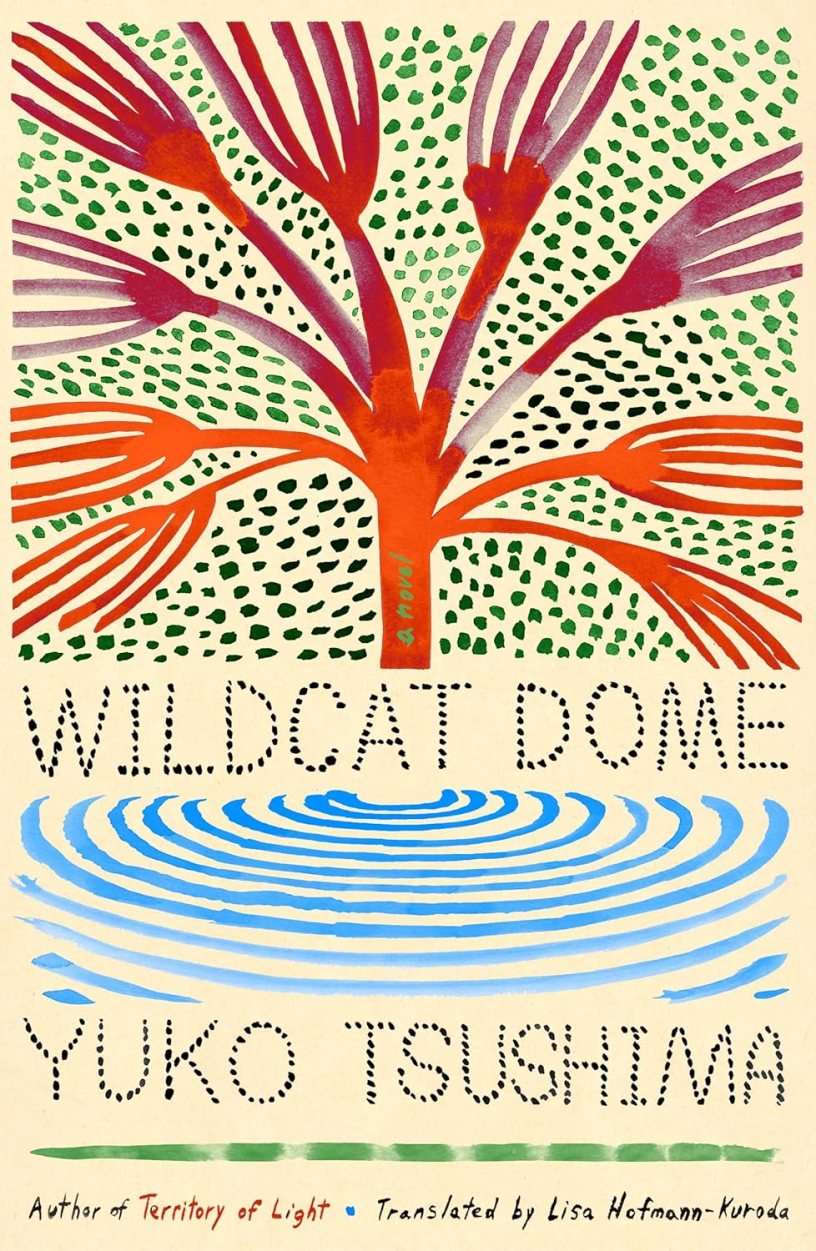
Wildcat Dome
By Tsushima Yuko
Translated by Liz Hofmann-Kuroda
2013, translated 2025
Picador
Tsushima’s most well-known works in English are her first two novels, Territory of Light (1979) and Woman Running in the Mountains (1980), considered to be elemental works in the Japanese canon and among the first to be directly associated with feminism. Wildcat Dome is the third novel in a trilogy Tsushima produced in the final years of her life and it is unrelenting in its critique of imperialism, war, and male violence against women, though we come to know her true targets slowly as they emerge from the mists of memory, grieving, longing, and multiple points of view. The main characters in the novel are born in 1947. Like all the children in the orphanage run by Mother Asami, Kaz (Kazuo) and Mitch (Michio) are mixed race, the sons and daughters of American GIs and Japanese women. A woman who works in the facility, Sister Yae, adopts them as her own and raises them as brothers, and her niece, the fully Japanese Yonko, becomes their playmate. They play exclusively with the other mixed-race orphans in a kind of ghetto, as the Japanese regard the children as a shameful reminder of their imperialism failure and their domination by America. At eight, they witness what may have been a murder or an accident, and the Japanese amplify rumors that American blood or radiation from the atomic bomb caused the tragedy. Shortly after, Sister Yae calls her sons to her side and explains that they will never have a good life if they continue to live in Japan, so she sends them to a school in England. Other children are sent to the United States, where Mother Asami imagines they will be more welcome. But where will Kaz, half-Japanese and half-white, and Mitch, half-Japanese and half-black, find a home? While always focused on the fraught relationship between Yonko and the two brothers, Tsushima slips across decades while surfacing handfuls of fellow orphans as they spread out across the world. As the cast of characters doubles and then doubles again, the multiple trajectories become difficult to manage, and even more so since they go by both their Japanese and European names. An orphan sent to America is drafted into the Vietnam War and goes missing. Another hangs himself. Yonko alone remains in Japan, while Kaz and Mitch wander across Europe. Kaz eventually finds peace in maintaining and designing Japanese gardens in New Zealand, though Mitch lives a restless life, drifting from job to job and from country to country. All along, though they hardly ever write or call one another, they are constantly in dialogue with one another, sharing their anxieties, appealing for help, praying on their behalf, and picking fights with their absent friends. Meanwhile, the world around them seems to have gone mad. They fear the next move of a Japanese serial killer, learn of the CIA’s involvement in violent revolutions, and witness the fall of the twin towers on 9/11 and the Iraq War. With the triple disaster of 3.11, The Great East Japan Earthquake, tsunami, and the resulting Fukushima Daiichi nuclear disaster, the scattered community of orphans reels, wondering if it’s them or their nation that is cursed.
On the vast beach resembling a desert, Mitch and Sonia are the only ones for miles around. A sandy gust of wind blows so fiercely that they can barely see ahead of them. The beach is on a cape that juts into a strait. Plenty of fishing boats have shipwrecked in this sea, the fisherman thrown overboard, their cold bodies washing ashore. Legend had it that many of them were British or from the Brittany region of France. When fragments of the ship washed ashore, people gathered them and created a small museum.
Mitch, I hear people pray there, too. After learning that their husbands, sons, and fathers died at sea, women, young and old alike, come from far away, dressed up in mourning clothes, to visit the coast. Some of them end up staying, settling down in a place that overlooks the beach. There they quietly live out the rest of their days, looking out at the sea that swallowed up their husbands, sons, and fathers.

